

You are using an out of date browser. It may not display this or other websites correctly.
You should upgrade or use an alternative browser.
You should upgrade or use an alternative browser.
Goyslop - Colors, Additives, Radiation, Sugar and Other Perils
- Thread starter Cynllo
- Start date

On Instagram and Telegram, I like Dr Eric Berg; he does short but informative nutrition and health-related clips:
Also on Instagram, thefoodbabe breaks down a lot of info about goyslop* and its ingredients
(*she doesn't call it that, haha)
It's best not to take nutrition advice from someone named foodbabe, just like you wouldn't take it from corrupt FDA. In this case she is probably just uneducated.
Rapeseed oils is extremely toxic stuff originally used only as machine oil and fried food in general isn't good for you, being highly cancerogebic and bad for stomach health, so UK is being poisoned by slightly different version of slop
Last edited:

Well, I'm judging by the content of her posts, not the color of her username. Pretty much everything she says checks out when compared to other sources.It's best not to take nutrition advice from someone named foodbabe, just like you wouldn't take it from corrupt FDA. In this case she is probably just uneducated.
Rapeseed oils is extremely toxic stuff originally used only as machine oil and fried food in general isn't good for you, being highly cancerogebic and bad for stomach health, so UK is being poisoned by slightly different version of slop
In the specific post I linked to, she's not implying that all the UK ingredients are good, indeed she has plenty to say about canola aka rapeseed oil (none of it good). She's simply pointing out there are fewer bad ingredients than the US slop version.

In USA, supermarkets, ice cream, no longer exists because it doesn’t meet the definition of ice cream. It’s mostly high fructose corn syrup plus food additives.

You wouldn't be hiding out in that quaint, little McDonalds. You'd be eating here...
Guys if you haven’t stopped eating fast food, please watch this
This isn’t exactly news, as Oreo cookies have been around for a very long time now
Rapeseed oil started out as an industrial lubricant for steam engines in WW2.
It worked well because:
- Stayed liquid in cold temperatures
- Didn't break down easily under heat
- Created smooth mechanical operation
World War II: Massive demand for rapeseed oil in naval machinery. Canada grows millions of acres specifically for industrial lubricant production.
1945: War ends. Massive rapeseed surplus. No longer needed for ships.
Problem: What do we do with millions of gallons of industrial lubricant?
Someone has a brilliant idea: "What if we just tell people to eat it?"
Problem: Rapeseed oil contains 50% erucic acid, which is toxic to humans. Causes heart damage in animal studies.
Solution: Selective breeding to create low-erucic-acid varieties. "Canola" = "Canadian Oil, Low Acid"
1970s: Launch massive marketing campaign. Rapeseed sounds industrial. Call it "Canola" instead. Sounds friendly. Natural. Wholesome.
"Heart healthy!" "Better than butter!" "Low in saturated fat!"
Within 20 years, Canola oil is in everything.
What they don't mention:
- Still requires chemical extraction using hexane
- Still highly refined using heat and chemicals
- Still oxidises rapidly when heated
- Still high in omega-6 inflammatory fatty acids
You're eating steam engine lubricant that was rebranded as food after the war ended and they needed something to do with the surplus.
Next time you see "heart healthy Canola oil," remember:
- You're buying industrial lubricant with better marketing.
- Your great-grandmother cooked with butter and tallow from her local farm.
- You cook with chemical-extracted, heat-damaged, petroleum-processed machinery oil from industrial agriculture.
Progress.
Last edited:

^ This reminds me of a bread video I recently watched.
Take home on the video is that pretty much any bread you buy shouldn't really be considered food but rather a manufactured product that looks like bread.
It's pretty shocking.
They go into what medieval bread was like and how laborers could "just eat bread" and have energy all day to build things like cathedrals.
What was amazing to me is that even how we now use steel to mill the grain destroys essential nutritional oils that are preserved by milling with stone (less heat).
I suspect AI generation with the voice, etc. But it's still very informative.
What we have for bread now is little more than poison. All for convenience and profit.
Take home on the video is that pretty much any bread you buy shouldn't really be considered food but rather a manufactured product that looks like bread.
It's pretty shocking.
They go into what medieval bread was like and how laborers could "just eat bread" and have energy all day to build things like cathedrals.
What was amazing to me is that even how we now use steel to mill the grain destroys essential nutritional oils that are preserved by milling with stone (less heat).
I suspect AI generation with the voice, etc. But it's still very informative.
What we have for bread now is little more than poison. All for convenience and profit.

^ This reminds me of a bread video I recently watched.
Take home on the video is that pretty much any bread you buy shouldn't really be considered food but rather a manufactured product that looks like bread.
It's pretty shocking.
The real test with bread is how fast it goes bad. Supermarket bread brands will not go bad after a couple of weeks in the back of th fridge, but bread bought from my local bakery will go moldy after a week or two, because it doesn't have industrial preservatives.

The new brand all the dumb girls are wearing is alo, it's all polyester. They are paying 10x markup for Walmart and temu clothes. I wear nice brands, don't get me wrong I won't wear anything that actually has the brand name displayed on it I'm not a billboard, but for my nice clothes I'll wear farragamo, Armani and Hugo boss among others because they fit well and last forever. So spending money on nice clothes i can't talk but to spend stupid money on polyester garbage has to be one of the dumbest things I can think of.
I was at Kroger yesterday looking for tortillas which should have like all of 5 ingredients. They were out of their organic brand which I usually get and they are delicious but had like 20 others I thought I could at least find one, nope they all had a CVS receipt worth of ingredients on the back.
I made meatloaf with my ground beef instead...

I wear nice brands, don't get me wrong I won't wear anything that actually has the brand name displayed on it I'm not a billboard, but for my nice clothes I'll wear farragamo, Armani and Hugo boss among others because they fit well and last forever. So spending money on nice clothes i can't talk but to spend stupid money on polyester garbage has to be one of the dumbest things I can think of.
Share the same approach - spending more for quality products, saves You more in the long term. Although I'm not a fan of the so-called luxury brands, I put more effort into finding locally-made quality brands. Also, I buy some of my clothes in the same place I buy boating supplies. Kinda joking, but not really.
Share the same approach - spending more for quality products, saves You more in the long term. Although I'm not a fan of the so-called luxury brands, I put more effort into finding locally-made quality brands. Also, I buy some of my clothes in the same place I buy boating supplies. Kinda joking, but not really.
Locally made brands huh? Give me some examples that's interesting....
Locally made brands huh? Give me some examples that's interesting....
We've always had some great designers/craftsmen they just got overshadowed, and in many cases put out of business by large retail brands. Things have changed with the onset of online sales - it became easy to find and order made in the USA quality gear, one just have to do some research. So for example, I got myself lately a pair of Wyoming-made sweaters. 100% wool, no synthetics, sourced and made locally.

What could go wrong?

 www.dailymail.co.uk
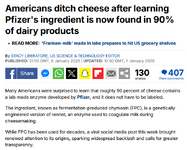
Americans ditch cheese after learning about Pfizer-linked ingredient
Pfizer developed a lab-made ingredient that is now found in roughly 90 percent of American cheese, and it does not have to be labeled.
Sooo.. what kind of cheese is now pure? I don't eat a lot of cheese but I think it contains some important things, like vitamin k2 to help our bodies synthesize vitamin D.
I am thankfully on an ice cream fast. I was getting addicted to it because "it's just cream and sugar" but it's clearly not. I've mostly purged goyslop from my diet, eating eggs and beef, drinking milk. I could still always try to find healthier options of what I do eat, but it's working out for me, I feel consistent wakefulness and energy throughout the day. I notice my coworkers, who drink coffee and energy drinks and are all fat, are all tired, yawning, and ready to throw in the towel around 2-3pm at work, when I'm just as awake as I was in my first hour and I have steady concentration.
I also wanted to mention my go-to soup these days is beef bone broth with butter and eggs and salt to taste.
I am thankfully on an ice cream fast. I was getting addicted to it because "it's just cream and sugar" but it's clearly not. I've mostly purged goyslop from my diet, eating eggs and beef, drinking milk. I could still always try to find healthier options of what I do eat, but it's working out for me, I feel consistent wakefulness and energy throughout the day. I notice my coworkers, who drink coffee and energy drinks and are all fat, are all tired, yawning, and ready to throw in the towel around 2-3pm at work, when I'm just as awake as I was in my first hour and I have steady concentration.
I also wanted to mention my go-to soup these days is beef bone broth with butter and eggs and salt to taste.
Sooo.. what kind of cheese is now pure?
You might have to go to a farmers market or the equivalent. For example, if you’re in Pennsylvania, you can buy from the Amish..
In some states, you can still buy raw milk, I imagine those same vendors probably sell cheese made from raw milk
It’s gotten to the point where actual food that you would buy from countries like Mexico, South America, Europe, or Asia, with no go additives? That’s the stuff you buy at a farmers market in the United States.. the food and drug administration, as apparently been bought out or sold out to their Jewish masters that want to keep pumping us full of goy slop