The Japan Thread

That makes sense!

Nagano eh? Interesting. I could forgo an Akita Bijin for a Yuki Hime ❄️😉
Yeah, Tokyo is the centre of the universe for pretty much everything over there. I just found it a bit lonely, and from what I gather it wasn't just me. Osaka for example is known for being more friendly: merchants instead of samurai (。。。 まて!).

I think it's at least a few degrees cooler when you go North of the Kanto area. But yeah, you have to put on Big Boy Pants living abroad anyhow.
Summer Temperatures in Tokyo, Sendai, Sapporo

In summer, summertime temperatures differ significantly between Tokyo, Sendai, and Sapporo due to their varying latitudes and regional climates. In Tokyo, summer temperatures typically range from 26°C to 32°C, with occasional highs exceeding 35°C, and the season is characterized by high humidity and frequent rainfall Sendai, located in the Tohoku region, experiences a slightly cooler summer with temperatures ranging from 20°C to 25°C, though it can still feel hot and humid during peak periods Sapporo, situated in Hokkaido, has the coolest summer climate among the three, with average highs around 24°C to 27°C, and temperatures generally remain more moderate and less humid compared to Tokyo and Sendai While Sapporo's summer is still warm, it is considered significantly cooler and more comfortable, making it a preferred destination for those seeking relief from the intense heat of central and southern Japan

Interviewing Japan had a banger of a video the other day about the dating problem.


It looks like his latest release is about the YoungJamez Kabukicho incident - お楽しみ !


I was just in Tohoku this past summer to escape a Tokyo heatwave that was getting relentless. If it's around 30, then I don't mind. But we had a couple days where it pushed past 35 and that is just wrong. I know it's Asia and I am familiar with 'Asia hot' but its still pretty exhausting.

Iwate and Akita are awesome, and I especially liked Iwate. The people in Akita can be pretty nice as well, but for me the Pacific coast is best. And the weather is just perfect - I am also a fan of Japanese weather. I love the fluffy white perfect clouds that grow over the course of a week then release in a thunderstorm, which give way to cooler temps and sunshine again for a spell. It's awesome.

The temps in Iwate were around 31 but nights were low 20s. We spent much of the time driving around and looking for swimming holes and onsen. Japan has some of the best swimming holes in the world, and in Iwate they are ENDLESS. I hear Shikoku is even better, too.

Sendai is a good sized city, but if I had to make the jump I would choose Morioka. Awesome people and it passed my 'happy high school' test. The pretty high school girls (of which there were plenty) all looked cheerful and content. Lots of happy looking young couples as well. We were in the onsens every day and the young Japanese lads were all pretty fit and athletic. My wife said the same from over in the girls onsen. This bodes well for the future of the region. Tokyo might not need to continue to be the black hole of youth anymore.
 
For full disclosure, I didn't like Japan. Didn't like how I was treated, didn't like how everything is set up, didn't like their attitude and overall felt like that part in an RPG where you walk into a town and everyone is acting weird, like under a spell. It's visually gorgeous, it's clean, functional and quite interesting but the other stuff wore me down.
An RPG ...I like this take 😂

Sleepy Narshe

The Scuzzy Zozo


Sendai is a good sized city, but if I had to make the jump I would choose Morioka.
The smaller size would seem to be more attractive. I'd go as rural as I could realistically handle. I'm sick of being coastal and wouldn't mind a promotion to mountain person. Sure, the ocean is beautiful and I'd like to visit now and then, but salt is bad for electronics, optics, health, etc. And of course, it seems like Shitlib NPCs gravitate towards the coasts. The Youtuber AbroadInJapan famously started out in Morioka, but now has moved on to Tokyo due to his immense status as King of Japan. Last I heard he had started his own bar (Lost) in Shibuya.

One problem with being a mountain person in Japan these days: bears! (Too many femoids have chosen bear ;) )


Yeah, that debt thing has been around for ages. I heard that the reason they haven't had to put up with what happened to Greece is that there is immense private wealth ... or something (not sure how that all works).
I've never seen an India Town over there but it makes sense that they'd be around, unfortunately.
 
He said it at the end, "vacation home". As I've stated before, good luck getting permanent residency as a western family unless you want to slave away as an English teacher (which soon becomes redundant) for years doing 60 hours a week.

That house is beautiful, I wonder if it's insulated though as most houses in Japan are not.

Not even in a place like this that is a few hours north of Tokyo? Average low in Dec/Jan is 0C...
 
The ancient Japanese could have learned something there from medieval northern Europe:


I know of a homeless guy who lived in an old abandoned coal mine who complained of being cold in a modern house once he got his act together. Maybe it was him weaning off heroin though.

Europeans in Kangaroo land complaining about the houses being cold in the mild winters here is another one that comes up.
 
Last edited:


Again you have to remember that these stats are only to provide one thing: Mass migration.

The truth of the matter is that Japan is turning its birth rate around. But of course when you include 50yo women in your "WHY AREN'T JAPANESE WOMEN PROCREATING!!!" studies, it's going to look horrible. But there is some glimmer of hope among the younger segment - you know, the ones who are actually capable of having babies. So while it might not be going up, it's no longer going down, or at least not nearly as quickly as predicted.

I know of a homeless guy who lived in an old abandoned coal mine who complained of being cold in a modern house once he got his act together. Maybe it was him weaning off heroin though.

Europeans in Kangaroo land complaining about the houses being cold in the mild winters here is another one that comes up.

I am Canadian and I was pretty cold in my house over the winter in Victoria. Tasmania was a bit better in their winter housing. But it's hard to beat Scandinavia for efficiency that's for sure. The Japanese traditionally just move from one heated element to another (bed-toilet-kotatsu-space heater-electric blanket-onsen-etc).
 
Japan is way too overcrowded.....they could halve their own population from 122 million to 61 million and actually vastly improve everyone's quality of life (especially regarding tiny living spaces and high rental costs).
 
Japan is way too overcrowded.....they could halve their own population from 122 million to 61 million and actually vastly improve everyone's quality of life (especially regarding tiny living spaces and high rental costs).
I think that they enjoy living in "hives" ;) . While there is some truth to this idea that much of Japan is very mountainous some people say that the lack of development there is due to their Asian tendency to want to clump together. It could be that with modern technological advancements mountainous areas are eminently habitable (mostly for the wealthy?).

On the flip side, I think the hysteria about population decline is a bit overblown. They can withstand a population decline for quite a while before things actually get critical. There are all of those small European countries which must have it worse.

I don't know much about traditional Japanese architecture, but there are a few different types of houses. Those ones with the huge thatched roofs might be alright for thermals. I know the modern ones get more sensible if you go up North. From the video above it seems like the indoor fire combined with a need to disperse humidity in the summer made for a not-so-cozy build.

Types of Traditional Japanese Homes

Traditional Japanese homes encompass a variety of types, each reflecting regional materials, craftsmanship, and historical context. The most common traditional types include minka (also called kominka), machiya, and nagaya Minka, or folk houses, were built for farmers and merchants and feature wooden beams, high ceilings, and thatched or tiled roofs These homes vary by region, such as the gassho-zukuri style in Shirakawa-go, which has steeply pitched roofs designed to withstand heavy snowfall, and farmhouses with space for livestock Machiya are urban townhouses with narrow facades, ideal for small plots in cities like Kyoto, often featuring a central courtyard or tsuboniwa garden They typically combined living and working spaces in a single building, with narrow plots and a tori-niwa passage leading from the front to the rear Nagaya are traditional row houses, commonly found in densely populated urban areas, where homes were built close together along streets

Other notable traditional styles include shinden-zukuri and shoin-zukuri, which were used by aristocrats and samurai, respectively. Shinden-zukuri, prominent during the Heian period, featured a central hall linked by corridors to other rooms, often with a pond to the south Shoin-zukuri, developed during the Muromachi period, centered on a reception room for guests and incorporated tatami flooring, sliding doors (fusuma and shoji), and an ornamental tokonoma alcove Sukiya and chashitsu styles emerged from the tea ceremony, emphasizing minimalism and harmony with nature, with the chashitsu serving as a symbol of Japanese-style simplicity These traditional homes often included features such as engawa (outer corridors), genkan (entrance halls for removing shoes), tatami flooring, and sliding paper screens, many of which continue to influence modern Japanese architecture

He said it at the end, "vacation home". As I've stated before, good luck getting permanent residency as a western family unless you want to slave away as an English teacher (which soon becomes redundant) for years doing 60 hours a week.
Generally marrying a Japanese person is the way to go for long-term stay but there are other arrangements. I don't know that teaching English is a "60 hours a week" kind of thing. Working at public schools is more of a 9-4 kind of thing, often with a lot of sitting around. But teaching language suits some people's disposition more than others. You're meant to run games and generally make the idea of learning the language seem more fun and real. Most of the teachers you work with in the schools don't have a high level of English, and sometimes they make errors. You have to contend with the fact that in Japanese culture you have to be very careful about correcting others because of "face culture". You end up doing things you don't agree with just to "do your job". In my experience It's a bit of a stretch to call the job teaching (but I don't really enjoy standing up in front of groups of people to begin with).

Foreigner Live in Japan

A foreigner can live in Japan for most of the year through several visa pathways besides marrying a Japanese national. The most common options include:

- **Work visa**: This requires sponsorship from a Japanese employer or a Japanese-based company. The foreigner must have a job offer and the employer must apply for the appropriate work visa on their behalf. The visa is typically granted for a period of one to five years and can be renewed

- **Student visa**: This allows entry for the purpose of studying at a Japanese educational institution. Students can work part-time (up to 28 hours per week) with permission from immigration authorities. After graduation, students may transition to a work visa if they secure employment

- **Digital Nomad Visa**: Japan introduced a new "Designated Activities" visa for remote workers, allowing a stay of up to six months. This visa requires proof of an annual income of at least 10 million JPY (approximately $68,000 USD) and is intended for those working remotely for foreign companies This visa does not lead directly to permanent residency but can be a pathway for temporary long-term stays.

- **Business Manager visa**: This is available to individuals who establish and manage a business in Japan. The applicant must have a company with a capital of at least 5 million JPY, a physical office in Japan, and meet experience and salary requirements. The visa is granted for up to one year and can be renewed However, purchasing property alone, such as an abandoned home (Akiya), does not qualify for this status, as it is considered passive investment

- **Working Holiday Visa (WHV)**: Available to citizens of certain countries (including the U.S., Canada, and Australia) aged 18 to 30, this visa allows a stay of up to one year with the possibility to work and travel. It is not renewable and does not lead to permanent residency, but it can be a starting point for longer-term stays

- **Permanent Residency**: While not a visa, permanent residency can be obtained after meeting specific criteria. For example, highly skilled professionals may qualify after one to five years of residence, while others typically need ten consecutive years of residence, provided they have maintained good conduct and have sufficient assets or independent living ability Permanent residency allows indefinite stay and any paid activity

Each of these pathways requires meeting specific legal and financial criteria, and the process involves applying through the Japanese Immigration Services Agency

I wonder what people think about the future of Christianity in Japan. Should all those shrines be torn down to make way for churches? Ideally how would things work out?
 
I've heard Texas could hold the whole world at the density of NYC (or was it Manhattan? nah).

Some more on local Christianity,

Hubert Schiffer was a German Jesuit priest who survived the Hiroshima bombing. I'm not sure how much radiation exposure he suffered- the time he spent rummaging among the city's ruins. Some sources say his companions were unscathed, others disagree. I guess if you handle a lot of objects emitting residual radiation and inhale a great deal of the polluted air your mileage will vary.

Not only were the clerics kept safe from the initial blast — they suffered no ill effects from the harmful radiation. Doctors who cared for them after the blast warned that radiation poisoning to which they had been exposed would cause serious lesions, illness and even death. But 200 medical exams in the ensuing years showed no ill effects, confounding the doctors who had predicted dire consequences.

Father Schiffer, who was only 30 years old when the bomb was dropped on Hiroshima, told his story 31 years later, at the Eucharistic Congress in Philadelphia in 1976. At the time, all eight members of the Jesuit community who had lived through the bombing were still alive.


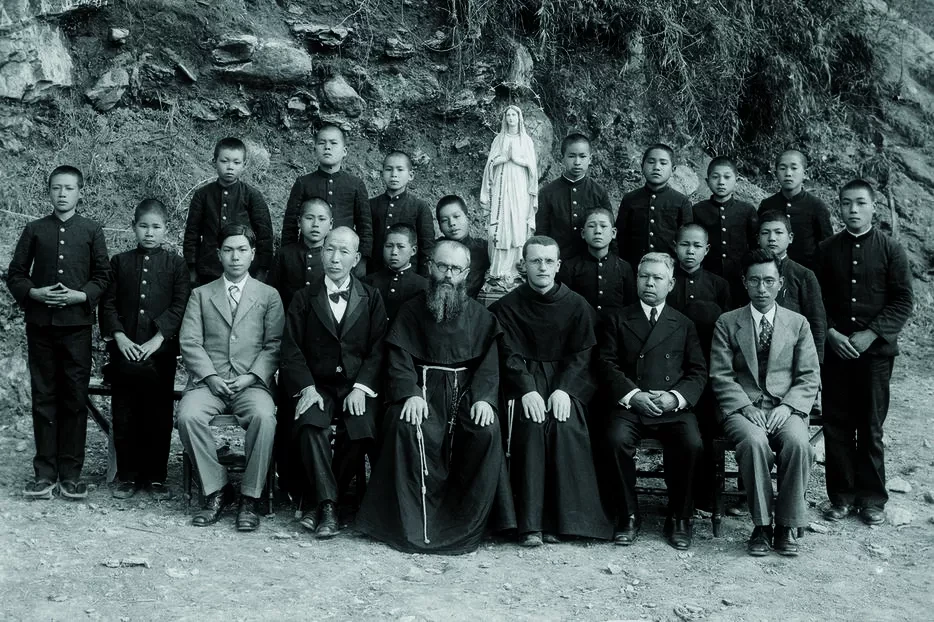
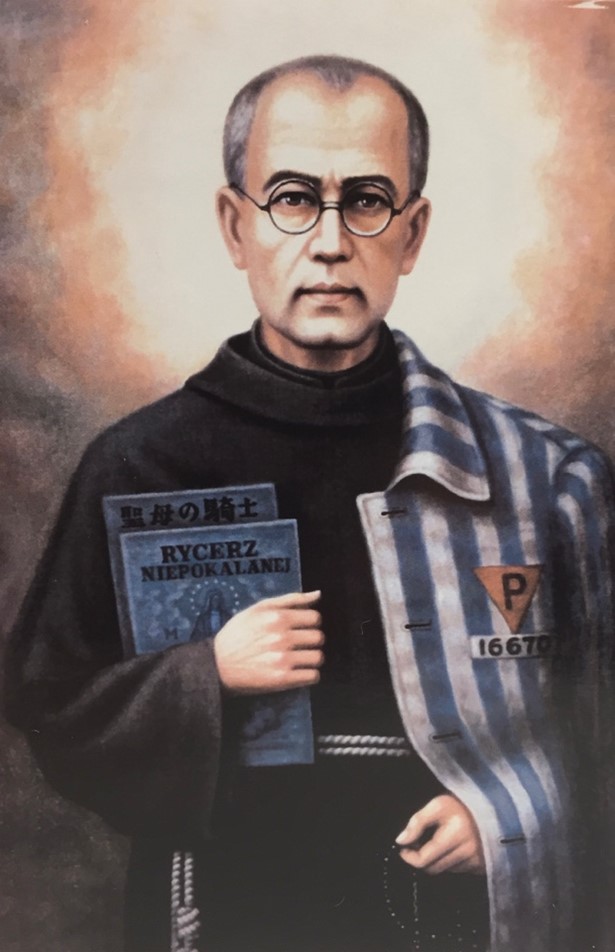
Max Kolbe is a Polish saint who started a mission in Nagasaki,

After six years of missionary work and experiencing several periods of poor health in Japan, Kolbe was asked to leave and return to care for his foundation in Poland in 1936.

Upon his return to Poland, Kolbe wrote a letter to a friend in Nagasaki that read: “I will never forget Japan; indeed, I always pray for it. I will work with every effort for the salvation of Japanese souls. The Japanese are a people who really search for authentic religion, so they will obtain many graces from the Lord God.”


There is a pious legend that Mugenzai no Sono was protected from the atomic bomb because of Our Lady’s guidance in selecting the original site, located behind some hills. The much older wooden Ōura Cathedral (built in 1864), where Maximilian and his friars had begun their work in Japan, also survived the atomic bombing, even though it was more exposed to the effects of the bomb. Ōura Cathedral and Mugenzai no Sono were over three miles from ground zero, and damage from the bomb was generally limited to two miles from the epicenter. Certainly, the hilly topography helped protect Mugenzai no Sono, but so did the distance.


Japan is way too overcrowded.....they could halve their own population from 122 million to 61 million and actually vastly improve everyone's quality of life (especially regarding tiny living spaces and high rental costs).
I largely agree with what you are saying in the very long run but there will be a prolonged painful financial adjustment period as the dependency ratio continues to worsen and every worker will have to support an increasing number of old people. It’s bitter medicine but far superior to the alternative of mass immigration which will only crush living standards even faster. There is no easy way out of this. The piper must be paid.
 
The state can promote aggressive pro-family measures including subsidies for stay at home mothers, discrimination against young women for corporate jobs in favor of mothers returning to the workforce after child rearing, cultural pro-family campaigns, clampdown on feminism etc. A lot of this runs against the liberal agenda and that of the zaibatsus who want women to keep working through their entire adult lives.
 
The state can promote aggressive pro-family measures including subsidies for stay at home mothers, discrimination against young women for corporate jobs in favor of mothers returning to the workforce after child rearing, cultural pro-family campaigns, clampdown on feminism etc. A lot of this runs against the liberal agenda and that of the zaibatsus who want women to keep working through their entire adult lives.

It is likely region specific, but a Japanese friend of mine as 'gifted' a new home in Niseko when they had their second child. There was also a grant available (not for Niseko, but for a region not too far away) to incentivise young couples to start businesses. I've heard Nagano and Iwate have had similar programs to some success.

Like most places, having children is a cultural issue. If you see more people your age with babies, you are more likely to have a baby. And then to see young couples with young children who seem happy it just adds more incentive. Most of the propaganda is centered around: They are too expensive. Work is life. Your personal time is too valuable. By removing some of these factors and reversing the message things will take care of themselves. All the government needs to do (or should do) is remove some of the barriers and perhaps add a bit of lube (ha).
 
Back
Top