NO no no no no
still doesn't understand panics/crashes happen because of intervention
The
short list of panics and crashes I posted previously all occurred in a time when the United States had no central bank, and thus intervention was impossible. Your statement is thus not only false, but impossible. The reality is that panics and crashes occur when there is a crisis of confidence leading to a sell-off and a demand for cash, creating banks runs. The issue is one of liquidity, and as the historical record has demonstrated, central bank intervention (and the liquidity it provides) has actually helped to alleviate both the frequency and severity of panics and crashes. Now, I'm the first to admit that this power CAN and HAS been abused in the past. But that is a consequence of the ignorance and active malfeasance of bad actors controlling the system,
not of the mechanics of the system itself. Both gold and Bitcoin, if they were integrated as backstops for currency issuance through fractionalization, could be manipulated and abused in similar fashion by bad actors.
Not allowed in the US, as full reserve banking would outcompete (and cause the collapse of) fractional reserve banks.
This is categorically impossible, for the simple reason that a bank utilizing fiat/fractional reserve lending needs far fewer assets than one that is fully backed. Take two real estate investors: one is able to finance properties using 99% borrowed money and 1% down, the other puts 100% of his own money down to buy each property. Which one do you think ends up collecting more monthly rents? Obviously, it's not even close. The same is true for a bank that is able to create credit money through debt. It's the basis of the whole system. It's why it's so powerful.
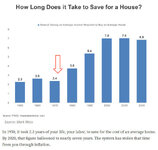
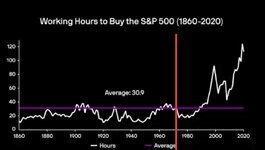
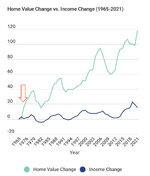
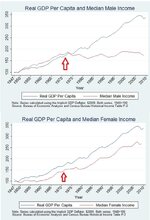
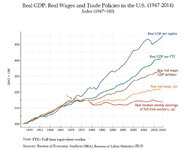
I have already addressed this argument before. Why has the GDP growth rate slowed, debt to GDP risen and income inequality and standard of living all deteriorated since 1971 when the last vestiges of the gold standard (the partial gold standard) were removed by president Nicon?
The evidence proves the exact opposite of what you claim.
You're confusing correlation with causation. First of all, the dollar was not on the gold standard in 1971 as far as domestic use goes (i.e. people were not taking dollars to the bank and demanding gold in exchange). It was backed by gold in terms of international trade flows, and when other countries began trying to cash in their dollars for gold, the peg was scrapped. This was inevitable due to the dollar's status as the global reserve currency and the corresponding balance of payments deficit that results due to foreign demand for dollars. The decline in standard of living and income inequality that started at that time had more to do with the 1970s economic malaise which led into the 1980s rise of corporate/crony capitalism and immigration, all of which combined to create downward wage pressure.
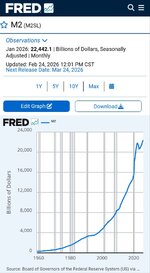
Except for the fact that there is no money to pay the interest on the loans without creating new money so it’s effectively a Ponzi scheme and as soon as the money supply stops expanding it all comes crashing down hence the current situation of an ever expanding Debt to GDP ratio. How do you think it will eventually end other than collapsing?
This is true. The mechanics of credit money creation do not create the interest attached to the debt. That money must be pulled elsewhere from the system (i.e. from credit money that originated with another loan). This is why fiat systems gradually inflate over time. It's sort of a game of musical chairs, but from a systemic perspective it works remarkably well and can be very stable if properly managed. As I pointed out above, the problem is not really the mechanics of fiat money, it's that bad actors have learned to abuse the system over time (as they also learned to abuse gold and would learn to abuse Bitcoin if that became the standard).
However this is changing as central banks around the world are feverishly accumulating gold so they can eventually I believe introduce a partially gold backed currency in the future (although it’s possible Bitcoin might get there first).
Any future gold-backed currency would quickly become fractionalized and inflated, same for a Bitcoin-backed currency. The genie of fractionalization is out of the bottle and is never going back in. It's simply too powerful and tempting a practice for those in control of the financial/banking system to ignore (and yes, there will
always be those in control of the system, the sort of stateless, totally independent currency
@chance vought dreams of Bitcoin becoming is just that, a dream).
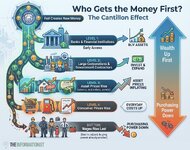
Let us assume that you pay back your $10,000 loan at the rate of approximately $900 per month and that about $80 of that represents interest. You realize you are hard pressed to make your payments so you decide to take on a part-time job. The bank, on the other hand, is now making $80 profit each month on your loan. Since this amount is classified as income to the bank, it is spendable. So this remains as spendable money in the account of the bank. The decision then is made to have the bank's floors waxed once a week. You respond to the ad in the paper and are hired at $80 per month to do the job. The result is that you earn the money to pay the interest by polishing the bank's floors at night. In other words, you are working for the bank to pay the bank the interest on the money you borrowed from the bank in the first place. And that's the way it is with the entire system.
, the borrower's labor directly flows back to the lender (the bank), making the debtor essentially a servant to the creditor for the "uncreated" interest portion.
the debt-money mechanism turns productive effort into perpetual tribute to the banking system.
The funny thing is that you are hitting on the right idea with this example, but you actually aren't taking it far enough, and thus you fail to understand how this concept is actually
a good thing. Rather than think about the guy in your example working directly for the bank, you need to insert several other layers. Let's say he's working for a car dealership, instead, and waxes their floors at night. He is obviously paid by them, and they make money by selling cars. One of the guys who just bought a car owns a dry cleaning business, and one of his best customers is a real estate investor who holds several mortgages with the bank. Thus the money created as debt flows from the bank, to the real estate investor, through the dry cleaner, through the car dealer, to the man waxing the floors, which he then uses to pay his rent to the real estate investor who owns the apartment he lives in, and the investor returns the money back to the bank to pay off the debt. There is an entire ecosystem of goods and services flowing from the original debt creation. The bank is not enslaving anyone, they are simply creating the money that acts as the blood of the economy and allows for the free exchange of labor, goods and services. This is the power of fiat currency to create economic growth.
The future of money in the transition period is STRC, or something like it. It is not convertible into BTC - but it is convertible into the currency people want, USD.
STRC is transparently a Ponzi scheme, and the inevitable collapse of Strategy will do catastrophic damage to Bitcoin when it occurs. The fact that Michael Saylor still hasn't even begun to present a viable plan for monetizing his Bitcoin stash should set all your alarm bells ringing. Borrowing money is not a business plan. Issuing shares is not a business plan. Bitcoin cannot be lended. It provides no yield. All of these "innovative financial products" Strategy is creating are nothing more than dressed up Ponzi schemes. You pay them money in exchange for promise of a dividend, they use that money to buy Bitcoin (which generates no yield) and pay off the dividends. If new money stops coming in, the entire schemes collapses and they will be forced to liquidate their Bitcoin. It is a mathematical certainty that this will happen, the only question is when.