
You are using an out of date browser. It may not display this or other websites correctly.
You should upgrade or use an alternative browser.
You should upgrade or use an alternative browser.
Iran-Israeli Conflict Thread
- Thread starter LaAguilaNegra
- Start date


Secretary of State Marco Rubio is expected to visit Israel on Monday — but some U.S. and Israeli officials think he might not go if Trump gives the order to strike Iran.
A tell to look for to see if the strikes are coming next week.

I still think this whole thing is little more than bluster meant to appease the Israelis and scare the Iranians into signing a disadvantageous deal. I expect to see some nominal bombings and missile strikes take place over the coming weeks, but I think Trump realizes that anything more than that would not only be extremely difficult for the U.S. military to sustain logistically, but would provide very little geostrategic benefit for the U.S., and would be politically disastrous to boot. At the end of the day, like all bullies, Trump operates mostly on hot air and bravado. He talks a big game and then ends up delivering very little before walking away and declaring victory. I'll be surprised if this latest brouhaha turns into anything more serious than the previous "war".

I'll be surprised if this latest brouhaha turns into anything more serious than the previous "war".
This whole scenario over the last three decades has been like a bad marriage between The Goy Who Cried Wolf and the movie Groundhog Day. Oh, "this time" Israel and Iran are going to go to the mat and "the US will put boots on the ground in Iran on behalf of Israel."
Ain't gonna' happen.
How many times can someone hear the same (((MSM))) proclamation before realizing it will never come true?
The question thus becomes, "Why would (((They))) keep pushing this same false narrative over and over again, year in year out, decade after decade, yet never actually pull the trigger?"
I think most men here can figure out an answer to that.
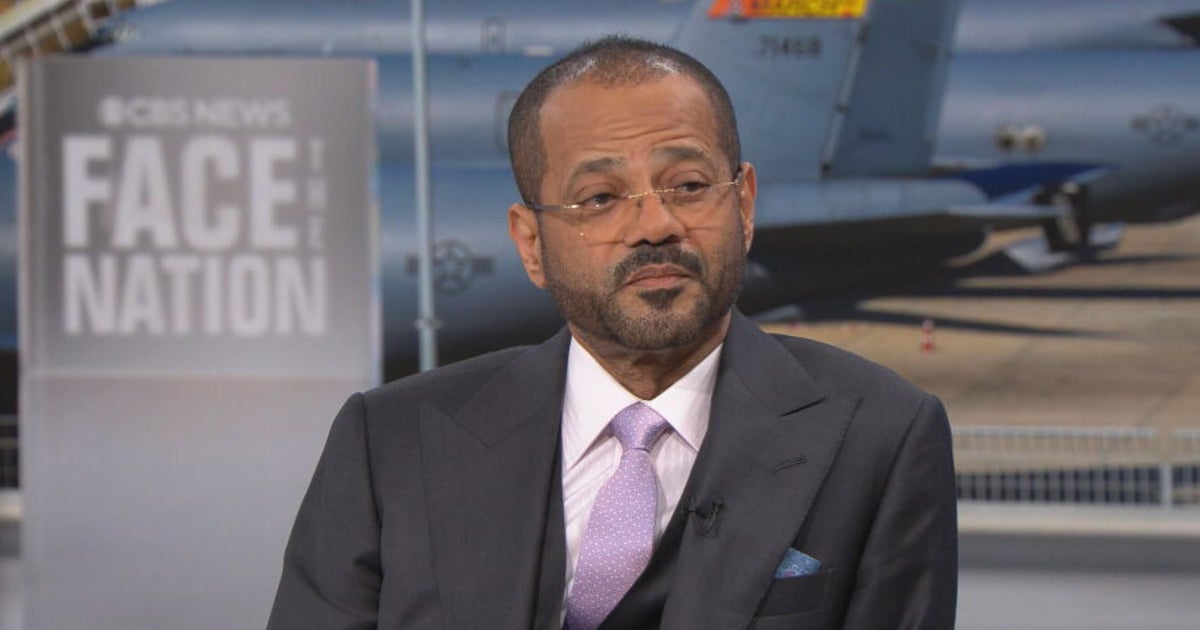
U.S.-Iran deal is "within our reach," Omani mediator says
Negotiators from the U.S. and Iran have made "substantial progress" toward a deal to curb Iran's nuclear program, Omani Foreign Minister Badr Albusaidi told CBS News on Friday.
 www.cbsnews.com
He said Iran has agreed that it will "never, ever have … nuclear material that will create a bomb," which he called a "big achievement." The country's existing stockpiles of enriched uranium would be "blended to the lowest level possible" and "converted into fuel, and that fuel will be irreversible," according to Albusaidi.
And Iran is willing to grant inspectors from the U.N.'s International Atomic Energy Agency "full access" to its nuclear sites in order to verify the terms of the deal, said Albusaidi.
"There would be zero accumulation, zero stockpiling, and full verification," he said. Albusaidi said that if there is a fair and endurable deal in place, he is "quite confident" that even American inspectors will have access at some point in the process.
Seems very at odds with what Trump was saying earlier today about his unhappiness with the current state of negotiations though.
Yes what Cooper said. Iranians are Indo-Europeans and come under the Indo-Iranian sub branch of Indo Europeans.Not that we need proof for this but if war starts on purim it will show that it's a religious war and nothing else. One more thing to boot: Iranians are Persians, Persians are Semites. How can Jews attack Iranians and not be considered antisemites then... Or maybe the Jews are really Khazars and all their semitic claims are simply bullshit...

Trump clearly wants to see Venezuela, Cuba, Yemen, Iran, and Afghanistan eliminated from the list of rogue anti-US states, he is taking steps to try to make this happen.
One can only assume North Korea is in his sights as well. That would make a clean sweep of troublesome small states, leaving only Russia and China, who are willing to bargain and cooperate.
Edit: Also the Mexican cartels.
One can only assume North Korea is in his sights as well. That would make a clean sweep of troublesome small states, leaving only Russia and China, who are willing to bargain and cooperate.
Edit: Also the Mexican cartels.

Look up what the word “Iran” means in Farsi and when they changed the name of their country from “Persia” to Iran and the reason why. I forget many here don’t listen to red pill podcasts.Yes what Cooper said. Iranians are Indo-Europeans and come under the Indo-Iranian sub branch of Indo Europeans.
It is worth it, trust me.

Please share these 'red pill podcasts', I'd like to have a laugh too. As for AS not being red-pilled on Iran, this member is with high certainty a diaspora Iranian himself, or at least from that part of the world - this is quite clear from his postings and positions.Look up what the word “Iran” means in Farsi and when they changed the name of their country from “Persia” to Iran and the reason why. I forget many here don’t listen to red pill podcasts.
It is worth it, trust me.
As for whatever theory you are alluding to, Persians are a sub-branch of the Iranic peoples. The Iranic peoples in itself are centered around Indo-European/ Yamnaya origin story and language but then again so are Hindus/ Indians with their Vedic emphasis, Indo-European language and Yamnaya originated caste system (meant to protect Yamnaya/ Brahmin Aryan racial purity+power structures through the generations and keep the Dasa/ Indus Valley aborigines from moving upwards.
Looking at the Indian Subcontinent today we see how that panned out, the Yamnaya conquerors have genetically vanished into that sea of brown underlings. Due to modern genemapping we know that in Northwestern India only 10-15 percent of DNA is derived from steppe pastoralist Yamnaya ancestry and that's only in the North West. In places like Kalkotta, where people speak the Indo European Bengali language, it's close to zero. The highest amount of Yamnaya DNA on the Subcontinent can be found in isolated Afghan mountain villages and upper class Pakistani circles, Imran Khan who is a Nyazi nobleman has very clear Yamnaya traits and in Nuristan blondism is not uncommon.
Yamnaya DNA share is higher in Iran but not by much. Modern Iranians are mostly comprised of ancient Zagrossian Neolithics, Southern Hunter Gatherers and then the gene influxes from the steppe (Yamnaya and later the Turkic khaganates), Iraq/Arabia, and the Indian Subcontinent. These modern findings and conclusions were already reached by National Socialist racial scientists in the 30s bytheway, people like Hans Gunther and Alfred Rosenberg talked up Iran's historical decay to the mixing of the original Yamnaya conquerors with the local brown host populations. Bringing in Germany's most famous racial scientists here because there's a high chance that this is what you are referring to.
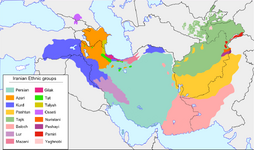
Persia and Iran(ics). High ancestry Yamnaya Sarmatian/ Scythians Iranics once dwelled the Central Asian steppes from Ukraine to Xinjiang but were in several waves eventually replaced by Turkics and Slavics.
EDIT : just noted they colored Azeris as Iranic. Very bold move, Azeris are genetically Causcasoids and have high Iranic admixture. Culturally and historically close to Iran too. Azerbaijan is an etymological Iranian word as well, Azeris consider themselves Turkic though so this map was made by probably an Iranian nationalist.
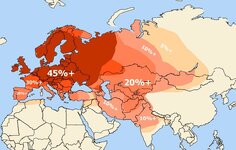
Percentage Yamnaya DNA. In Iran these fair skinned horseriding steppe pastoralists would be called Aryans.
Last edited:
Israeli attack on Iranian targets. Size, scope and number of targets yet unknown. State of emergency has been declared in Israel. Attack coincided with a relatively large attack on Hezbollah targets in Lebanon
Last edited:
Does any of this have anything to do with when or why they changed the name of their country?Please share these 'red pill podcasts', I'd like to have a laugh too. As for AS not being red-pilled on Iran, this member is with high certainty a diaspora Iranian himself, or at least from that part of the world - this is quite clear from his postings and positions.
As for whatever theory you are alluding to, Persians are a sub-branch of the Iranic peoples. The Iranic peoples in itself are centered around Indo-European/ Yamnaya origin story and language but then again so are Hindus/ Indians with their Vedic emphasis, Indo-European language and Yamnaya originated caste system (meant to protect Yamnaya/ Brahmin Aryan racial purity+power structures through the generations and keep the Dasa/ Indus Valley aborigines from moving upwards.
Looking at the Indian Subcontinent today we see how that panned out, the Yamnaya conquerors have genetically vanished into that sea of brown underlings. Due to modern genemapping we know that in Northwestern India only 10-15 percent of DNA is derived from steppe pastoralist Yamnaya ancestry and that's only in the North West. In places like Kalkotta, where people speak the Indo European Bengali language, it's close to zero. The highest amount of Yamnaya DNA on the Subcontinent can be found in isolated Afghan mountain villages and upper class Pakistani circles, Imran Khan who is a Nyazi nobleman has very clear Yamnaya traits and in Nuristan blondism is not uncommon.
Yamnaya DNA share is higher in Iran but not by much. Modern Iranians are mostly comprised of ancient Zagrossian Neolithics, Southern Hunter Gatherers and then the gene influxes from the steppe (Yamnaya and later the Turkic khaganates), Iraq/Arabia, and the Indian Subcontinent. These modern findings and conclusions were already reached by National Socialist racial scientists in the 30s bytheway, people like Hans Gunther and Alfred Rosenberg talked up Iran's historical decay to the mixing of the original Yamnaya conquerors with the local brown host populations. Bringing in Germany's most famous racial scientists here because there's a high chance that this is what you are referring to.
Persia and Iran(ics). High ancestry Yamnaya Sarmatian/ Scythians Iranics once dwelled the Central Asian steppes from Ukraine to Xinjiang but were in several waves eventually replaced by Turkics and Slavics.
EDIT : just noted they colored Azeris as Iranic. Very bold move, Azeris are genetically Causcasoids and have high Iranic admixture. Culturally and historically close to Iran too. Azerbaijan is an etymological Iranian word as well, Azeris consider themselves Turkic though so this map was made by probably an Iranian nationalist.
View attachment 27652
Percentage Yamnaya DNA. In Iran these fair skinned horseriding steppe pastoralists would be called Aryans.
View attachment 27650
Because Persia was an imposed label which the Shah of the day (1930s) didn't like, anti-colonialism and such. The term Persia had in those days already become a narrowed down concept which did not in the slightest include the other Iranic peoples (Lur, Balochs, Kurds etc) which populated Iran hence the name change, inclusion avant la letter so to say. Furthermore Persia (derived from Parsa, home of the Acheimenids, Persepolis etc.) is a Greek term whilst Iran is a native word.Does any of this have anything to do with when or why they changed the name of their country?
Name changes are of all ages, not sure what your red pilled podcasters whispered into your ear and why. Istanbul was Constantinople before, New Rome before that and Byzantium before that. It's often related to status and dominance. Iran represents the Iranic peoples and the Iranic homeland, Persia doesn't because it represents Persians and a specific (Parsa/Fars) region.
For the most part I would largely agree with what you are saying here but will add the following notes:Looking at the Indian Subcontinent today we see how that panned out, the Yamnaya conquerors have genetically vanished into that sea of brown underlings. Due to modern genemapping we know that in Northwestern India only 10-15 percent of DNA is derived from steppe pastoralist Yamnaya ancestry and that's only in the North West. In places like Kalkotta, where people speak the Indo European Bengali language, it's close to zero. The highest amount of Yamnaya DNA on the Subcontinent can be found in isolated Afghan mountain villages and upper class Pakistani circles, Imran Khan who is a Nyazi nobleman has very clear Yamnaya traits and in Nuristan blondism is not uncommon.
Yamnaya DNA share is higher in Iran but not by much. Modern Iranians are mostly comprised of ancient Zagrossian Neolithics, Southern Hunter Gatherers and then the gene influxes from the steppe (Yamnaya and later the Turkic khaganates), Iraq/Arabia, and the Indian Subcontinent. These modern findings and conclusions were already reached by National Socialist racial scientists in the 30s bytheway, people like Hans Gunther and Alfred Rosenberg talked up Iran's historical decay to the mixing of the original Yamnaya conquerors with the local brown host populations. Bringing in Germany's most famous racial scientists here because there's a high chance that this is what you are referring to.
-In any case even if the percentage of Indo-European genetics is arguably on the low side in Iran the total genetic makeup of Iranians on average is still quite different from those of the Semites (Arabs and Israeli's etc). You don't need a degree in anthropology to see this. Just take 10 Iranians at random and stand them next to 10 Israeli's or 10 Arabs and the contrast will be clear enough.
-Looking at Indo-European genetics is a little more complictaed than that and this thread delves into the topic a bit deeper:
The question was posed: "What percentage of Indo-European genes in different ethnic groups of the world?"
Here is what was written in one of the replies:
"What you're probably after is steppe ancestry, but steppe ancestry =/= Indo-European genes. The connection between Steppe_EMBA and Proto-Indo-European is well confirmed but in a lot of places Indo-European languages weren't spread by people that were 100% Steppe_EMBA. Proto-Indo-Iranians for example were 70% Steppe_EMBA for instance. So in their case, what are the Indo-European genes? The 70% steppe_EMBA or the 100% Proto-Indo-Iranian Steppe_MLBA ancestry?
In Northern Europe, do we measure just by steppe_EMBA or Corded Ware related ancestries? Because the Indo-Europeanization was done by populations who already were admixed with other populations (on top of the admixing within Steppe_EMBA) which would elevate their contribution to modern population genetics.
Norwegians might have 55% steppe ancestry but CWC ancestry is probably akin to 70% ancestry in Norwegians. So do they have 55 or 70% Indo-European genes?
The peoples of the British Isles might have 48% steppe ancestry but they basically have 80-90% Bell Beaker ancestry (from various BB descendant populations).
I think you get the point I'm making here.
On that note even with just steppe ancestry using different source populations can make a difference as well. Some of the steppe samples in western Ukraine had higher degrees of Western Hunter Gatherer and Early European farmer ancestry, and when you use those to calculate the amount of steppe ancestry in European populations you'd get a higher amount than using Yamnaya samples from Samara. And to be fair because of the increased statistical fits these populations are probably more representative of the Indo-Europeans who migrated to the west than the Yamnaya samples from Samara.
So to get the "true" amount of steppe ancestry of a population you'd have to select the most relevant steppe samples for that particular population, and to calculate the amount of Indo-European genes (genetics of the introducers of Indo-European languages in the region) you'd need the more proximate samples which would genetically resemble the population which brought the languages into the region."
But yes in any way you cut it or define it, its undeniable that people living in Iran today have a lower percentage of Indo-European genetics than people in Europe do (generally speaking). You can just see this visually without needing a degree in anthropology or anything.
Also a very interesting discussion here with the first poster although I do disagree with a fair bit of what he says he has interesting takes:
Last edited:
Yes pretty much this sums it up. And just for further context here is the Google AI answer on this topic:Because Persia was an imposed label which the Shah of the day (1930s) didn't like, anti-colonialism and such. The term Persia had in those days already become a narrowed down concept which did not in the slightest include the other Iranic peoples (Lur, Balochs, Kurds etc) which populated Iran hence the name change, inclusion avant la letter so to say. Furthermore Persia (derived from Parsa, home of the Acheimenids, Persepolis etc.) is a Greek term whilst Iran is a native word.
Name changes are of all ages, not sure what your red pilled podcasters whispered into your ear and why. Istanbul was Constantinople before, New Rome before that and Byzantium before that. It's often related to status and dominance. Iran represents the Iranic peoples and the Iranic homeland, Persia doesn't because it represents Persians and a specific (Parsa/Fars) region.
Yes"Iran" historically means "Land of the Aryans."
Derived from the ancient Proto-Iranian term Aryānām (meaning "of the Aryans"), the name reflects the migration of Indo-Iranian tribes (nomadic Indo-Europeans) into the Iranian Plateau around 1000–800 BCE. The term Arya refers to an ethno-linguistic group, not a modern race.
Key Historical and Linguistic Context
- Origin of the Name: The name Iran is a modern Farsi derivative of older terms like Airyanem Vaejah (Avestan) and Aryānām.
- "Aryan" Meaning: In this contextAryan (from Arya) was a self-designation of the Indo-Iranian peoples, signifying a cultural, linguistic, and religious identity, rather than a racial classification.
- Not "Persia": While the West knew the country as "Persia" (derived from the Fars region and the Achaemenid Empire), its inhabitants referred to it as IranIranshahr, or Iranzamin for millennia.
- Official Name Change: In 1935, Reza Shah requested that the international community use "Iran" to reflect the country's native, historical name.
- A Complex Identity: While rooted in this ancient terminology, modern Iran is a mosaic of peoples, with thousands of years of blending with neighboring populations, making the "Aryan" label a historical and linguistic designation rather than a contemporary description of racial purity.

US and Israel launch "pre-emptive" attack against Iran
Israel said it launched a pre-emptive attack against Iran on Saturday, pushing the Middle East into a renewed military confrontation and further dimming hopes for a diplomatic solution to Tehran's long-running nuclear dispute with the West.
 www.reuters.com
"An Israeli defence official said the operation had been planned for months in coordination with Washington, and that the launch date was decided weeks ago."
Once again, the "negotiations" were only a deceptive sham. Trump was always going to do what his Zionist overlords wanted.
According to semi-conventional history there were several Indo-European migrations into Iran, two of those are mixed up here. The first migration wave was the Yamnaya steppe pastoralists mentioned earlier above, this was around 1800 BC. The second migration wave were the Persians and Medes into Iran at around 1000 BC. These were at that point branches of the Andronovo Culture. The 1000 BC part refers to the migration of the Persians and Medes into the Iranian Plateau/ Zagros Mountains.Yes pretty much this sums it up. And just for further context here is the Google AI answer on this topic:
Yes"Iran" historically means "Land of the Aryans."
Derived from the ancient Proto-Iranian term Aryānām (meaning "of the Aryans"), the name reflects the migration of Indo-Iranian tribes (nomadic Indo-Europeans) into the Iranian Plateau around 1000–800 BCE. The term Arya refers to an ethno-linguistic group, not a modern race.
Key Historical and Linguistic Context
Although the 1000 - 800 BCE part of the AI answer is arguably up for debate but the rest is seemingly more or less accurate I would say.
- Origin of the Name: The name Iran is a modern Farsi derivative of older terms like Airyanem Vaejah (Avestan) and Aryānām.
- "Aryan" Meaning: In this contextAryan (from Arya) was a self-designation of the Indo-Iranian peoples, signifying a cultural, linguistic, and religious identity, rather than a racial classification.
- Not "Persia": While the West knew the country as "Persia" (derived from the Fars region and the Achaemenid Empire), its inhabitants referred to it as IranIranshahr, or Iranzamin for millennia.
- Official Name Change: In 1935, Reza Shah requested that the international community use "Iran" to reflect the country's native, historical name.
- A Complex Identity: While rooted in this ancient terminology, modern Iran is a mosaic of peoples, with thousands of years of blending with neighboring populations, making the "Aryan" label a historical and linguistic designation rather than a contemporary description of racial purity.
Migration waves from the Central Asian steppes into historical Iran has been a continuum in later eras as well, it's where Timur Lenk, Gengis Khan etc. came from
Yamnaya
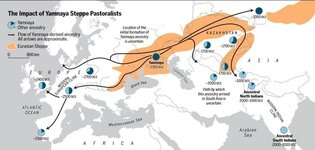
Persians and Medes
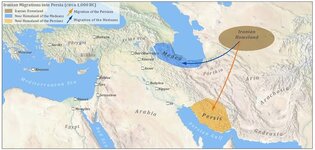
Last edited: