Protestantism: Critique and Debate Thread

@Giordano Bruno

So far, my question hasn't been addressed. In my opinion, miaphysitism and dyophysitism, both properly understood, amount to nothing more than a semantical difference. If you insist that it's more than a semantical difference, then lay out what the practical difference is.

Dyophysitism doesn't deny that the divine nature is united with the human nature. They affirm the hypostatic union. If you're saying that the two natures are united in such a way that they are mixed or conflated then that is indeed monophysitism, which is heresy.
As I said. The Bible says God is One.

It would be pretty odd if the Bible didn't include a description of Christ's own Nature, wouldn't it?

Practically speaking, I think knowing the Truth brings you closer to God. Though, there is a humility in not thinking oneself discerning enough to find it.

Miaphysitism gets a bad rap because it gets confused for monophysitism and because the Second Council of Ephesus was a fiasco. To be clear, I recognize the difference between monophysitism and miaphysitism, but the imprecision of miaphysite language can lead to monophysitism.

I do not consider miaphysitism to be heresy, in fact, anyone who believes in the hypostatic union already affirms a oneness, but I favor the dyophysite formula because it better safeguards against monophysitism.

What do you mean by safeguarding better?

Why would you decide theology based on how to avoid heresy? Isn't that something that we have examples of actually leading to heresy multiple times?

The truth is the truth. Do not fear. He promised the Church would never end in Daniels 2.

 
As I said. The Bible says God is One.
It also describes Jesus as God and man.

Practically speaking, I think knowing the Truth brings you closer to God. Though, there is a humility in not thinking oneself discerning enough to find it.
This is still too vague. Are you saying that miaphysites are closer to God than dyophysites because of the terminology they use?

What do you mean by safeguarding better?

Why would you decide theology based on how to avoid heresy? Isn't that something that we have examples of actually leading to heresy multiple times?
I mean that dyophysite language is clearer and therefore doesn't slope into monophysite heresy as easily as miaphysitism does. One of the chief points of the councils was to decide on theology that best avoids heresy.
 
It also describes Jesus as God and man.

Let me quote Pope Shenouda III because to be honest I am not as versed in this subject as I should be.

"Naturally, as long as we consider that this Nature is One, the Will and the Act must also
each be one. What the Divine nature Chooses is undoubtedly the same as that chosen
by the human nature because there is not any contradiction or conflict whatever
between the will and the action of both.


The Lord Jesus Christ said: "My meat is to do the Will of Him that sent Me to finish His
work. " (Jn. 4:34). This proves that His Will is the same as that of the Father. In this
context, He said about Himself "The Son can do nothing of Himself, but what He sees
the Father do, for what things soever He does, these also does the Son likewise. " (Jn.
5:19).

He does not seek for Himself a will that is independent of that of the Father.
Consequently He Says "Because I seek not Mine Own Will, but the Will of the Father,
who has sent Me. " (Jn. 6:38).

It is obvious that the Father and the Son in the Holy Trinity have One Will, for the
Lord Jesus Christ said: "I and My Father are One," (Jn. 10:30).
Hence, since He is one with Him in the Godhead, then He is essentially one with Him
concerning the Will. Again, the Son, in His Incarnation on earth, was fulfilling the Will of
the heavenly Father. Thus it must be that He Who united with the manhood had One
Will.

If there was not unity between the Will of the Divine nature of Christ and His human
nature, this would have resulted in internal conflict. Far be it from Him! How then could
Christ be our guide and our example... to follow in His footsteps (1 Jn. 2:6)?.
The complete righteousness which marked the life of our Lord Jesus was due to
His Divine as well as His Human will.


This is still too vague. Are you saying that miaphysites are closer to God than dyophysites because of the terminology they use?
Not because of terminology, I believe it is a more accurate belief. To speak of two after the Union has happened is inaccurate.

I mean that dyophysite language is clearer and therefore doesn't slope into monophysite heresy as easily as miaphysitism does. One of the chief points of the councils was to decide on theology that best avoids heresy.
I did not know that.
 
Not because of terminology, I believe it is a more accurate belief.
So far, you haven't provided an example of how it draws you closer to God. You're essentially saying "My terminology will draw you closer to God than your terminology will." I could simply assert the same thing, but it would be meaningless. Unless you can give a pragmatic difference in what the terminology results in, the issue is still only theoretical and semantical.

To speak of two after the Union has happened is inaccurate.
Am I allowed to recognize that the divine nature is not the same thing as the human nature after the union or do I have to believe that they are identical to each other?

"Thus it must be that He Who united with the manhood had One Will."
"The complete righteousness which marked the life of our Lord Jesus was due to
His Divine as well as His Human will."
So which is it? Does Jesus have only one will or two, a divine and human will?
 
So far, you haven't provided an example of how it draws you closer to God. You're essentially saying "My terminology will draw you closer to God than your terminology will." I could simply assert the same thing, but it would be meaningless. Unless you can give a pragmatic difference in what the terminology results in, the issue is still only theoretical and semantical.

I think I've come up with something.

So, before Christ was born, he didn't have a human nature yet right?

That's why Saint Cyril says after the Union we do not speak of two.

In this way Dyophysitism is vague temporally. It implies that the Union hasn't finished yet.

In essence it does not clearly testify the birth of Christ.

This I think is why Jews can join the Roman Catholic Church to subvert and then leave. It is like a gap in a fortress.

Am I allowed to recognize that the divine nature is not the same thing as the human nature after the union or do I have to believe that they are identical to each other?

Saint Cyril certainly did, but he also affirmed that the Union made them as one.

It's not a case of being allowed either. What matters is a Churches Official Theology. As laity we follow the Church.

That's why I brought it up. Protestants are weirdly diverse in opinion yet in some ways they are not.

You have Jehovah's Witnesses, but no Miaphysites. It seems strange to me.

So which is it? Does Jesus have only one will or two, a divine and human will?

The implication is that like him being his own Divine person, he has his own will. Yet like how we submit our Will to him to join with God, he submits his Will to the Father in his perfect humility.

He is without sin, yet he chooses to serve the Father.
 
That's why I brought it up. Protestants are weirdly diverse in opinion yet in some ways they are not.

You have Jehovah's Witnesses, but no Miaphysites. It seems strange to me.
I don't grant that JW's are Protestants or even Christians. Not only are they not Trinitarian, they outright deny Sola Scriptura, asserting the necessity of human tradition.

The Reformers, being descendents of the Western tradition, were Chalcedonian in their Christology. The West was always Chalcedonian. It was only in the East that this issue was as controversial as it was.

The implication is that like him being his own Divine person, he has his own will. Yet like how we submit our Will to him to join with God, he submits his Will to the Father in his perfect humility.
My point is the source you cited speaks of two wills after the Incarnation. Not a will of Jesus and a will of the Father, but two wills of Jesus. This is no different than Chalcedonians recognizing a distinction of the two natures after the Incarnation as well.
 
My point is the source you cited speaks of two wills after the Incarnation. Not a will of Jesus and a will of the Father, but two wills of Jesus. This is no different than Chalcedonians recognizing a distinction of the two natures after the Incarnation as well.

I do not think Wills are the same as Natures. Afterall, isn't it 3 Divine Persons, not 2, as One Being that is the True God?

That brings me to another point which I nearly forgot about.

Pope Shenouda III in the source I read brought up that the complexity of the Trinity and the inability to fully understand it is an argument in it's favour.

It is a Divine Mystery. The Sun can burn your eyes out from a distance of 92 million miles, so we should not expect to easily comprehend the nature of it's creator.

I feel that Miaphysitism matches this, while Dyophysitism does not. Two Natures that are united is rather simple. One Nature of Both Man and God in which neither are changed, altered, mingled, separated or divided.

We confess that our Lord and God and Saviour and King of us all, Jesus Christ, is perfect God with respect to His Divinity, perfect man with respect to His humanity. In Him His divinity is united with His humanity in a real, perfect union without mingling, without commixtion, without confusion, without alteration, without division, without separation. His divinity did not separate from His humanity for an instant, not for the twinkling of an eye. He who is God eternal and invisible became visible in the flesh, and took upon Himself the form of a servant. In Him are preserved all the properties of the divinity and all the properties of the humanity, together in a real, perfect, indivisible and inseparable union.
 
I do not think Wills are the same as Natures. Afterall, isn't it 3 Divine Persons, not 2, as One Being that is the True God?
What's funny about this is that the Monophysite controversy had implications for another controversy about a century later, Monothelitism. The logic is that the will is a product of the nature, and if Christ is said to have two natures, then He must also have two wills. To speak of two wills already implies a Chalcedonian Christology, or at least shows it's necessity.

I feel that Miaphysitism matches this, while Dyophysitism does not. Two Natures that are united is rather simple. One Nature of Both Man and God in which neither are changed, altered, mingled, separated or divided.
The real mystery is the Hypostatic Union, which both Miaphysitism and Chalcedonianism affirm.

That said, I don't think deciding the truth of one or the other based on it's mystery factor is the best way to go about things. That is more of the Greek philosophical approach, but my concern is over what aligns best with what the Scriptures teach. That will be the deciding factor for me.
 
What's funny about this is that the Monophysite controversy had implications for another controversy about a century later, Monothelitism. The logic is that the will is a product of the nature, and if Christ is said to have two natures, then He must also have two wills. To speak of two wills already implies a Chalcedonian Christology, or at least shows it's necessity.
It is rather amusing yes, though I would argue it doesn't make Chalcedon necessary. If the two natures are unchanged and unaltered but yet unified in One, we should surely assume the same of the Wills also.

The real mystery is the Hypostatic Union, which both Miaphysitism and Chalcedonianism affirm.

That said, I don't think deciding the truth of one or the other based on it's mystery factor is the best way to go about things. That is more of the Greek philosophical approach, but my concern is over what aligns best with what the Scriptures teach. That will be the deciding factor for me.
For that, I can only refer to my previous arguments that the Bible repeatedly says that God is one.

Galatians 3:20
King James Version
20 Now a mediator is not a mediator of one, but God is one.

Romans 12:5
King James Version
5 So we, being many, are one body in Christ, and every one members one of another.

Surely, if we ourselves are one body in Christ, there is no need to say that Christ Natures are two either, for they have joined, as we join with him.
 
It is rather amusing yes, though I would argue it doesn't make Chalcedon necessary. If the two natures are unchanged and unaltered but yet unified in One, we should surely assume the same of the Wills also.
Correct, and yet he spoke of two wills anyway. Even he sees the necessity of recognizing the distinction in the two natures (Chalcedonian Christology). He may not be consistent with it, but it's unavoidable. At some point, you have to speak about two wills and two natures unless you utterly conflate them.

For that, I can only refer to my previous arguments that the Bible repeatedly says that God is one.

Galatians 3:20
King James Version
20 Now a mediator is not a mediator of one, but God is one.

Romans 12:5
King James Version
5 So we, being many, are one body in Christ, and every one members one of another.

Surely, if we ourselves are one body in Christ, there is no need to say that Christ Natures are two either, for they have joined, as we join with him.
These are not comments on Christ's nature(s).

"God is one" in Galatians 3:20 is not about Christ's human and divine natures but about God directly ratifying the Abrahamic Covenant to Abraham without a mediator (as opposed to the Law).

As for Romans, do you believe that Christ's body is a divine body or a human body?
 
Correct, and yet he spoke of two wills anyway. Even he sees the necessity of recognizing the distinction in the two natures (Chalcedonian Christology). He may not be consistent with it, but it's unavoidable. At some point, you have to speak about two wills and two natures unless you utterly conflate them.


These are not comments on Christ's nature(s).

"God is one" in Galatians 3:20 is not about Christ's human and divine natures but about God directly ratifying the Abrahamic Covenant to Abraham without a mediator (as opposed to the Law).

As for Romans, do you believe that Christ's body is a divine body or a human body?
So a good friend of mine talked with me today. He's my first Soul Father's son Abba Michael.

We briefly touched on this subject and he brought up Metaphysics because it's one of his passions.

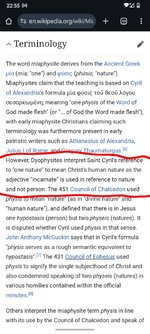
One thing he found really strange is that point I mentioned about the Wikipedia article saying Dyophysite argue Saint Cyril was Dyophysite because he was Miaphysite.

I'd appreciate help finding if that's true, because it still makes no sense to me.

The other thing was that he said we exist on different planes. There is an older self and younger self, and a self in a darker place and in a lighter place. But they are all you.

Just as the Saints said that the Bible has many parables. It is not merely literally true, it is also metaphorically true, spiritually true and scientifically true.

For God is the truth.

Of course this doesn't make my specific interpretation better than yours, but I think it's a beautiful way to look at the Bible, since the whole point of Christ descending to us was God becoming Man so that Man could become God.

In that sense, we become One. I think in both Nature and Being also. We may not agree on this, and I will admit to bias since I of course believe my Church is right, but do you understand where I am coming from?
 
One thing he found really strange is that point I mentioned about the Wikipedia article saying Dyophysite argue Saint Cyril was Dyophysite because he was Miaphysite.
Both sides like to claim Cyril for their own. Chalcedonians believe they're accurately reflecting Cyril's theology, just as Miaphysites do.

Of course this doesn't make my specific interpretation better than yours, but I think it's a beautiful way to look at the Bible, since the whole point of Christ descending to us was God becoming Man so that Man could become God.
I agree that Miaphysitism lends itself to the Theosis schema better. That said, Theosis is more of an Eastern emphasis. Theosis was popularized by an Alexandrian theologian, Athanasius, the same school that championed Miaphysitism. For the West, the overarching emphasis was not in trying to have man become God but to have man reconciled to God, which Chalcedonianism lends itself to very nicely since the two natures emphasize the duality that God unifies.
 
I agree that Miaphysitism lends itself to the Theosis schema better. That said, Theosis is more of an Eastern emphasis. Theosis was popularized by an Alexandrian theologian, Athanasius, the same school that championed Miaphysitism. For the West, the overarching emphasis was not in trying to have man become God but to have man reconciled to God, which Chalcedonianism lends itself to very nicely since the two natures emphasize the duality that God unifies.

On this, I think I agree with you.
 
When you take it too far:

When Christmas Was Really Under Attack

The Puritans and the original “war on Christmas."

Daniel N. Gullotta


(...) it wasn’t until the middle of the nineteenth century that many Christmas traditions, such as gift-giving and sending seasonal cards, started to emerge in their recognizable forms. Only in the 1860s did Christmas start to gain recognition by various states as a legal holiday; not until June 26, 1870, did Congress declare December 25 a federal holiday.

What took so long? As strange as it might sound, the original “war on Christmas” was among Christians.

Because of Protestantism’s emphasis on biblical authority, some groups, like the Puritans, found the scriptural justification for Christmas lacking. While Jesus’ birth is referenced repeatedly and narrativized twice (Matthew 1:18-25; Luke 2:1-7), December 25 is never referenced. The question of Christmas’s origins also became disputed, with Protestant theologians arguing that the celebratory date and many of its customs were pagan in origin, which seemed to lend credence to the Protestant belief that Catholic practices had corrupted Christianity. Through his own exegetical calculations, Robert Skinner’s Christs Birth Misse-timed (1649) argued that earlier Christians had miscalculated the date, further demonstrating that “all error cometh from Rome.”

The prolific Puritan pamphleteer William Prynne’s Histriomastix (1632) lambasted Christmas as nothing more than repacking of the Greco-Roman festival of Saturnalia by “paganizing Priests and Monks of popish (the same with the heathen Rome).” Likewise, Thomas Mockett, the Puritan rector of Gilston in Hertfordshire, argued that Christmas had been a Catholic plot to convert the unconverted masses using “riotous drinking, health drinking, gluttony, luxury, wantonness, dancing, dicing, stage-plays, interludes, masks, mummeries, with all other pagan sports.” The First Book of Discipline (1560), drafted in part by Scottish reformer John Knox, claimed Christmas among the things “that the Papists have invented.” Across the Atlantic world, Puritan clergymen and pamphleteers railed against Christmas as another “popish” and “pagan” error that true Christians need to do away with.

In addition to fierce anti-Catholic sentiment, the Puritan attacks on Christmas were also fueled by concerns over the indulgent conduct and frenzied atmosphere the holiday seemed to produce. It should be noted, despite their modern-day image as a grim lot who never knew how to have a good time and always wore black (when in fact, they wore all sorts of colorfully ‘sadd’ outfits), Puritans could be a merry bunch. They enjoyed drinking, singing, dancing, and sex as much as their less religiously extreme neighbors. But during these recreational activities, Puritan leaders always worried about the temptation of excess and were concerned that the festivities would become unchristian distractions. William Prynne complained of how Christians on “solemn feasts of Saints, especially of St. Nicholas,” would “honor Bacchus more than God” through “drunkenness and disorder.” Philip Stubbs, another provocative Puritan pamphleteer, described Christmas a time of “great wickedness,” bemoaning how such banqueting would devolve into scenes of mischief, with “dicing & carding” as well as “whordome.” Other Puritans also lamented how the true meaning of Christmas, namely the incarnation of Jesus, seemed lost on people who were instead more focused on partying. Given that the lead-up to Christmas often featured festivals and feasting, gateways to gluttony, drunkenness, mischief, and promiscuity, it is little wonder why the Puritans came to view the holiday with scorn.

Puritan efforts to quash the observance of Christmas did not manifest from pulpit preaching alone, but also through legal efforts and government action. With the Puritans in power in England following the execution of Charles I and the establishment of Cromwell’s Commonwealth, Parliament held regular sessions on December 25 to dispel any notion that there was something special about the day. In addition to fining those who desecrated their churches with seasonal decorations and threatening imprisonment to ministers who preached on the Nativity, Parliament outlawed Christmas plays in 1642. It upped the ante in 1647 by designating December 25 as day of repentance, signifying that it should be used for fasting, not feasting.

On this side of the Atlantic, the Mayflower Pilgrims likewise shunned the holiday, spending their first December 25 in the newly established Plymouth colony building houses. The Massachusetts Bay Colony also did not celebrate Christmas and passed a law in 1659 fining anyone “found observing any such day as Christmas or the like, either by forbearing of labor, feasting, or any other way” five shillings.

The Quakers of Pennsylvania also left Christmas unobserved for many of the same reasons. Unsurprisingly, New England almanacs dropped all references to December 25 as the date of Christ’s birth and references to Christmas celebrations are few and far between in colonial documentary records. In true Puritan style, Increase Mather wrote from New England in his pamphlet Against several Prophane and Superstitious Customs (1687), “The manner of Christ-mass-keeping, as generally observed, is highly dishonourable to the Name of Christ.”

But Christmas did not go down without a fight in England or the colonies. In the mother country, strict orders for markets and shops to remain open fell on deaf ears and for those who lived beyond the direct control of Puritan governance typically carried on with the festive merriment regardless. But Puritan mayors could also face protest through the holiday adornment of churches and businesses—as well as serious public backlash in the form of pro-Christmas rioting.

Meanwhile, the arrival of non-Puritans to the Plymouth and Massachusetts Bay colonies complicated the situation for those who had sought to escape England in order to form their own godly society. Only one year into his tenure as Plymouth’s governor, William Bradford encountered a group of newcomers to the colony who had excused themselves from work on December 25. Coastal towns like Marblehead in Massachusetts garnered a reputation for Christmas celebrations, much to the disapproval of their Puritan neighbors. One fisherman, William Hoar of Beverly (whose wife, Dorcas, was among the accused witches at Salem in 1692), hosted friends for Christmas drinking in 1662. Furthermore, as Stephen Nissenbaum has highlighted, the very existence and wording of the 1659 law “suggests that there were indeed people in Massachusetts who were observing Christmas in the late 1650s.” In fact, in 1659, the Massachusetts General Court remarked that there were “some still observing such festivals as were superstitiously kept in other countries,” like Christmas. Such details and data demonstrate the lingering Christmas spirit even in Puritan America.

With the restoration of the monarchy, many of the English laws decreed under Puritan rule were overturned, including the ones against Christmas. But the Puritans of New England resisted these changes. Puritan ministers continued to rage against holiday from the pulpit and in their personal writings long after the Massachusetts Bay Colony repealed the ban on Christmas. In a particularly dramatic display in 1686, the newly appointed governor, Sir Edmund Andros, surrounded himself with bodyguards at a Boston Christmas service for fear of protesters. Given this hostile environment and these anti-Christmas traditions, throughout the seventeenth and eighteenth centuries Christmas remained a minor event for most American colonists. As Penne L. Restad observes, “It would take the project of nation-building in the wake of the Revolution to begin to define an American conception of Christmas.”

While today’s hand-wringing about the supposed war on Christmas centers on imagined attacks on American Christianity, there is a rich irony in the fact that the longest and most sustained critique of Christmas—including its banning—came from those who were claiming to be the truest and purest defenders of the reason for the season.

www.thebulwark.com/p/when-christmas-was-really-under-attack
 
When you take it too far:
For some reason I have a respect for people who are so earnest in their search for Christ they don't celebrate these things. I say this as someone very into tradition. I get where they are coming from. They don't trust the culture. "Trust" and "culture" are the key words here.

Even now I can't decide if I think the secularized "Holiday season" is good... because it can have the effect of pulling people in, or bad because it's such a disgusting deformation of what Christmas is.
 
For some reason I have a respect for people who are so earnest in their search for Christ they don't celebrate these things. I say this as someone very into tradition. I get where they are coming from. They don't trust the culture. "Trust" and "culture" are the key words here.

Even now I can't decide if I think the secularized "Holiday season" is good... because it can have the effect of pulling people in, or bad because it's such a disgusting deformation of what Christmas is.
I think they're against religious commemorations. There were laws to keep businesses open on Christmas day. The secular aspect is secondary, and I can do without it, but I'm not against it in any way, have fun when you have a chance while you're still able- whatever gets you through the night. I remember- among us Pollacks- encountering semi drunk, smelling of alcohol dummies during midnight mass, which should be scoffed at of course.
 
The Bible came out of the old one, here a brand new tradition is born. They're having a good time with the music, but there's conformism too.

Not exactly going back to the origins, rather something post and extra biblical


I will take the Charismatic critique on the chin. That said, you will find a fair share of criticism from conservative Protestants towards the Charismatic movement due it's lack of emphasis on Scripture. These aren't the kind of people to spend hours deep diving into what the Bible means in it's original context. You can find similar quackery in the mystical sides of RCism and EOism.
 
For some reason I have a respect for people who are so earnest in their search for Christ they don't celebrate these things. I say this as someone very into tradition. I get where they are coming from. They don't trust the culture. "Trust" and "culture" are the key words here.

Even now I can't decide if I think the secularized "Holiday season" is good... because it can have the effect of pulling people in, or bad because it's such a disgusting deformation of what Christmas is.
I go to a conservative Reformed church. We have an elder who does not celebrate Christmas for desire to abstain from pagan syncretism. A real old-school Presbyterian. The other elders do celebrate Christmas but no one in the church disrespects his non-observance. Personally, I do respect his non-observance and see where he's coming from.

Here's a brief input from Grok on the topic:
The first formal celebration of Christmas on December 25 as the birth of Christ occurred in Rome in 336 AD, during the reign of Emperor Constantine, who had effectively made Christianity the favored religion of the Roman Empire through actions like the Edict of Milan in 313 AD. However, there is no direct evidence that Constantine personally issued an edict or decree establishing Christmas as an official holiday; this appears to have been a decision by the Church in Rome, possibly influenced by his support for Christianity and efforts to supplant pagan festivals like Sol Invictus.
Emperor Theodosius I (r. 379–395 AD) made Christianity the official state religion via the Edict of Thessalonica in 380 AD, but this did not specifically establish or formalize Christmas as a holiday. Later, Theodosius II (r. 408–450 AD) banned cruel circus games on Christmas Day in 425 AD to promote a more Christian observance, but this was a regulation on an already existing feast rather than its creation.
Christmas was not made a full civic public holiday—prohibiting work and public business across the empire—until Emperor Justinian declared it so in 529 AD.
In summary, neither Constantine nor Theodosius I directly made Christmas a formal holiday, though its initial formal church observance began under Constantine's rule, and later emperors like Theodosius II and Justinian added legal protections and status to it.

My own take on the matter is that it falls under Romans 14:
5 One person judges one day above another, another judges every day alike. Each person must be fully convinced in his own mind. 6He who regards the day, regards it for the Lord, and he who eats, eats for the Lord, for he gives thanks to God; and he who does not eat, for the Lord he does not eat and gives thanks to God.

What I will say about Christmas in our current context is I find how it's normally practiced to be distasteful. It has become increasingly secularized and corporatized.

 
Back
Top