The Off-Topic and Random Thoughts Thread(Anything Goes!)

I have been studying Japanese and it let me to learn something interesting about the etymology of the days of the week. Apparently the ancient Babylonians developed a system of naming the days of the week after the planets/gods, which spread both westward to Greece/Rome (later Germanic lands) and eastward to China and later Japan. However the matching of the planets/gods and the days actually stayed completely consistent across cultures after all these years, only diff being that Japanese/Chinese system viewed the planets as kind of elemental deities rather than anthropomorphized ones apparently. Somewhat ironically China has now switched to a numerical days of the week system whereas Japanese preserves the ancient one.

English (Germanic)RomanJapanese
Sundaydies Solis日曜日 (Sun Day)
Monday (Moon Day)dies Lunae月曜日 (Moon Day)
Tuesday (Tyr's Day)dies Martis (Mars = Tyr)火曜日 (Fire Star Day = Mars)
Wednesday (Woden's Day)dies Mercurii (Mercury = Odin/Woden)水曜日 (Water Star Day = Mercury)
Thursday (Thor's Day)dies Jovis (Jupiter = Thor)木曜日 (Wood Star Day = Jupiter)
Friday (Frigga's Day)dies Veneris (Venus = Frigga)金曜日 (Gold Star Day = Venus)
Saturday (Saturn's Day)dies Saturni土曜日 (Earth Star Day = Saturn)

Not sure if we got any other etymology nerds on here, I think it's a very underrated element of study that unlocks a lot when you look at the origins of language. I wonder if there were ever any autistic Christian sects who tried to redo the names of the week because of their pagan roots.
I noticed this with Dutch vs English, except instead of Thor's Day, they have Thunder Day (Donderdag), which is still a reference to Thor. The other Dutch days are direct equivalents of the English words.
 
I have been studying Japanese and it let me to learn something interesting about the etymology of the days of the week. Apparently the ancient Babylonians developed a system of naming the days of the week after the planets/gods, which spread both westward to Greece/Rome (later Germanic lands) and eastward to China and later Japan. However the matching of the planets/gods and the days actually stayed completely consistent across cultures after all these years, only diff being that Japanese/Chinese system viewed the planets as kind of elemental deities rather than anthropomorphized ones apparently. Somewhat ironically China has now switched to a numerical days of the week system whereas Japanese preserves the ancient one.

English (Germanic)RomanJapanese
Sundaydies Solis日曜日 (Sun Day)
Monday (Moon Day)dies Lunae月曜日 (Moon Day)
Tuesday (Tyr's Day)dies Martis (Mars = Tyr)火曜日 (Fire Star Day = Mars)
Wednesday (Woden's Day)dies Mercurii (Mercury = Odin/Woden)水曜日 (Water Star Day = Mercury)
Thursday (Thor's Day)dies Jovis (Jupiter = Thor)木曜日 (Wood Star Day = Jupiter)
Friday (Frigga's Day)dies Veneris (Venus = Frigga)金曜日 (Gold Star Day = Venus)
Saturday (Saturn's Day)dies Saturni土曜日 (Earth Star Day = Saturn)

Not sure if we got any other etymology nerds on here, I think it's a very underrated element of study that unlocks a lot when you look at the origins of language. I wonder if there were ever any autistic Christian sects who tried to redo the names of the week because of their pagan roots.
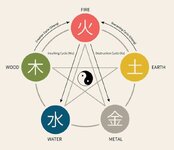
Although they have adopted a modern and simplistic convention for naming the days with numbers, Chinese cosmology of the five elements 五行 wu xing, shown in the chart above (Japan uses the same ideograms), is very interesting.

The Five Elements is one of three prevalent philosophies that is applied to various parts of Chinese culture, including medicine, and categorizes all things into the domain of one of those symbols based on its observed interactions with the other four elements.

The so-called Yin-Yang symbol in the center of the Five Elements flowchart below is the Tai Ji Tu 太極圖, which is another philosophical system of understanding the interaction of forces.

Such philosophies of non-material forces and their understanding is almost extinct in the post-Enlightenment, materialist West, but even Mao could not wipe it out in China, not that he specifically tried, but so much else was lost.

The chart below shows the observed patterns of different elements creating, destroying or attenuating other elements. Some of the jargon is symbolic and flowery.

In Chinese medicine, wu xing provides a conceptual model that allows for diagnosis and treatment that a few Chinese medicine docs I know have told me is about 80% or more reliable for treatment and predicting how things will go.

1000034222.jpg
 
Although they have adopted a modern and simplistic convention for naming the days with numbers, Chinese cosmology of the five elements 五行 wu xing, shown in the chart above (Japan uses the same ideograms), is very interesting.

The Five Elements is one of three prevalent philosophies that is applied to various parts of Chinese culture, including medicine, and categorizes all things into the domain of one of those symbols based on its observed interactions with the other four elements.

The so-called Yin-Yang symbol in the center of the Five Elements flowchart below is the Tai Ji Tu 太極圖, which is another philosophical system of understanding the interaction of forces.

Such philosophies of non-material forces and their understanding is almost extinct in the post-Enlightenment, materialist West, but even Mao could not wipe it out in China, not that he specifically tried, but so much else was lost.

The chart below shows the observed patterns of different elements creating, destroying or attenuating other elements. Some of the jargon is symbolic and flowery.

In Chinese medicine, wu xing provides a conceptual model that allows for diagnosis and treatment that a few Chinese medicine docs I know have told me is about 80% or more reliable for treatment and predicting how things will go.

View attachment 27204

I failed to give an example, so perhaps food will be instructive. To the five elements are attributed characteristics related to a topic, like food, which is a subset of the health/medicine topic.

火 Fire bitter
金 Earth sweet
金 Metal pungent (spicy)
水 Water salty
木 Wood sour

The usefulness of the Five Elements is that personal homeostasis is analogous to the natural order, where the various forces are seeking equilibrium. The relationship between the elements can instruct how to balance one's diet in order to maintain an internal equilibrium of energy systems, ie. organs.

In Chinese philosophy, the function (spirit) has primacy over the form (material). Therefore, the physical organ is the form, but it is the particular function, the energy, related to that organ that directs and motivates, and interoperates with the other organs according to the observed pattern of the Five Elements.

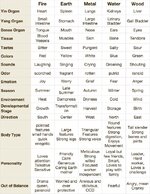
A very simplistic reliance on the chart is that if there are symptoms that reflect too much sweet food has been consumed, then more sour food will balance the problem because Wood "destroys" Earth. It would be known to a Chinese medicine practitioner what types of foods to increase or decrease based on a diagnosis that reveals the relative strength or weakness of the organs (energy systems) that are also categorized, see chart below.

For example, if a pulse diagnosis showed that a person's heart energy was weak, which is categorized within the Fire element, then very generally speaking eating more sour food would be helpful because sour food is categorized within the Wood element, and Wood "creates" Fire. This is a simplistic example, but not a realistic one, which would be much more complex.

This is hardly an adequate explanation, but I hope it gave a little insight to the application of the philosophy and reveals some of the depth of the naming conventions for the days of the week and how much ancient thought was involved in something we now barely recognize.

1769779364700.jpeg

Not everything in this chart is perfectly standardized or universally accepted, but pretty much everything down to and including direction is alright.
 
Last edited:
I saw this today from @lichthauch on my Twitter feed and appreciate it very much:

I knew a man who lost everything and he became softer. i knew another man who lost everything and he became a monster. same fire different metal. the pain did not decide. they decided. and most people do not know they are deciding.

the ones who transmute pain are dangerous in the good way. they have been somewhere you have not been and they came back with something and you can feel it when they walk into a room. they are not pretending to be okay. they are actually okay and that is terrifying to people who are pretending.

pain that is not transmuted gets transmitted. you will give it to your children. you will give it to everyone you touch. it will leak out of you sideways in ways you cannot see and everyone else can

i do not trust people who have not suffered. there is nothing there yet. they are still theoretical. suffering is the entrance exam and some people fail it forever and some people pass it once and become real.

the secret is you have to go toward it. you have to want it more than it wants you. most people run and the pain follows. the ones who turn around and walk into it come out the other side and there is another side and no one told you because the ones who know cannot explain and the ones who explain do not know.

God buries the gold in the wound


Back
Top