The Movie Thread

Francis Ford Coppola is selling his watch collection after his latest big movie flop cost him millions.

This is after selling $600m worth of wine vineyards


He owns a lot if property, which probably has a lot of upkeep and could have pulled the equity from it already, so he really could be broke. But he’s got to still make money from residuals on the godfather and apocalypse now etc

Edit, Francis ford Coppola is very much jewish so there’s some irony in a billionaire jew going broke, even if he still owns a few hundred million in property and has income from past films

What was the film of his that flopped?
 
Edit, Francis ford Coppola is very much jewish so there’s some irony in a billionaire jew going broke, even if he still owns a few hundred million in property and has income from past films
Naw, that ain't right. He was born to Italian immigrants and raised Roman Catholic.

DVD extras of him leading cast & crew in mystery religion type prayers and other things have always made me think that he's a Freemason, not to mention the subtext of some scenes in The Conversation (1974), as well as the plots of Youth Without Youth (2007) and Tetro (2009), which I'm pretty sure are recycled mystery religion stories.

In a 2007 interview he gave the impression that he was not Christian.

Are you religious? I think I am very religious.

You’re an observant Catholic? Oh, no, no, no. I was raised as a Catholic, but I didn’t like the Catholic Church at all. I thought the nuns were mean.

Do you believe in the afterlife? I sort of think that the people I have loved and lost are somehow still there. I can’t believe that something so specific is gone.

Coppola wrote the climactic final scene of the film where the main character is looking for an electronic surveillance device inside his apartment, so he literally tears apart everything inside, but when he gets to a small, cheap statuette of the Virgin Mary, he initially leaves it alone so that it's the last thing he deconstructs.

Then the main character comes back to the statuette and tries to break it open, but it's plastic (get the symbolism, wow) and it won't break, so he literally rips it open like a secret scroll to find there's nothing inside. I mean, NOW do you get the symbolism? Wow.

My biased opinion is that no real Christian would write such a subtly blasphemous scene that disparages the Church through Mary, but that's just me.

 
Naw, that ain't right. He was born to Italian immigrants and raised Roman Catholic.

DVD extras of him leading cast & crew in mystery religion type prayers and other things have always made me think that he's a Freemason, not to mention the subtext of some scenes in The Conversation (1974), as well as the plots of Youth Without Youth (2007) and Tetro (2009), which I'm pretty sure are recycled mystery religion stories.

Yeah I did a quick search on “is Francis ford Coppola jewish?” And one of the first results was “he is descended from Russian and Hungarian jews” but it was talking about one if the actors in his films, it’s too late to go back and edit that out of my first post
 
Yeah I did a quick search on “is Francis ford Coppola jewish?” And one of the first results was “he is descended from Russian and Hungarian jews” but it was talking about one if the actors in his films
Freemasonry is basically crypto-Judaism, so he isn't, but he probably is, lol.

Not that it really matters, but you can ask a mod to edit an old post to correct an error.
 
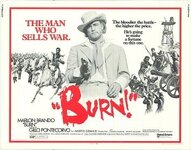
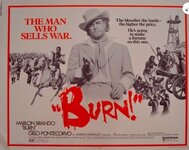
Queimada [aka Burn!] (1969) is a rare, if not unique, film that exposes the colonial and free trade politics of the 19th century and views them through the very cynical, but human eye of its agent provocateur main character, played well by Marlon Brando, and within a desperate Marxist point of view of capitalism. There's been nothing else in English I know of that handles this subject matter so well.

The director, Gillo Pontecorvo, is also known for The Battle of Algiers (1965), a film about the successful guerilla uprising against the French colonists.

1764819401044.jpeg

This director's cut with 20 minutes that had always been missing from the English language version has brief sections in Italian with English subs provided by the uploader. Run time of 2 hours, 8 minutes.


Attachments

  • 1764819275598.jpeg
    1764819275598.jpeg
    209.9 KB · Views: 1
One Battle After Another was a very entertaining movie, and a really interesting perspective. Basically it’s Antifa vs Ice/Border Patrol film that spans over several decades. All characters are flawed and varying degrees of bad/evil, basically which makes it an interesting watch. Sean Penn, Leo DeCaprio and Del Toro have solid performances. Penn’s character is a complete Psycho in this film. Worth checking out.
 
Queimada [aka Burn!] (1969) is a rare, if not unique, film that exposes the colonial and free trade politics of the 19th century and views them through the very cynical, but human eye of its agent provocateur main character, played well by Marlon Brando, and within a desperate Marxist point of view of capitalism. There's been nothing else in English I know of that handles this subject matter so well.

The director, Gillo Pontecorvo, is also known for The Battle of Algiers (1965), a film about the successful guerilla uprising against the French colonists.

View attachment 25900

This director's cut with 20 minutes that had always been missing from the English language version has brief sections in Italian with English subs provided by the uploader. Run time of 2 hours, 8 minutes.


Let me add this content warning:

There are several scenes with topless natives, but no sex, and minimal violence by today's standards, with nothing terribly graphic. There's a an execution by garroting while tied to a pole (large, screw-type garrot for slow strangulation), beheading seen from a distance, three corpses with their eyes gouged out and lids sewn shut, and a few shootings with little blood shown.
 
Living where I do, where the water goes down the drain clockwise, most of what I know about 'Straya comes through the telly, so here's one of the best films ever made down under, Wake in Fright (1971), directed by Ted Kotcheff, who also helmed First Blood (1982) starring Sylvester Stallone.

Wake in Fright is about an effete school teacher stuck in the middle of the outback and who's trying to get to Sydney for the Christmas holiday, but who gets himself stranded in a town full of proper Aussies, those who like to wrestle roos and drink Victoria Bitter, then wrestle each other.

The 1970's were all about demoralization cinema, for example, Walkabout, a much better known Australian film from 1971 that normalizes spurious suicide and indicts the entire white race while atavizing the noble savage aboriginal. Wake in Fright makes its main character the vessel for all of its demoralizing but allows the audience to enjoy the mostly wholesome, or at least vivacious characters around him.

Despite being greenlit for having a depressing protagonist, Wake in Fright has a style and a tone that is interesting and suspenseful, while also providing a character study that reveals the bourgeois effete personality to be a hollow man with no awareness of the weakness that his privation from primitiveness has caused him.

Includes the most graphic kangaroo fight scene in history.

 
Living where I do, where the water goes down the drain clockwise, most of what I know about 'Straya comes through the telly, so here's one of the best films ever made down under, Wake in Fright (1971), directed by Ted Kotcheff, who also helmed First Blood (1982) starring Sylvester Stallone.

Wake in Fright is about an effete school teacher stuck in the middle of the outback and who's trying to get to Sydney for the Christmas holiday, but who gets himself stranded in a town full of proper Aussies, those who like to wrestle roos and drink Victoria Bitter, then wrestle each other.

The 1970's were all about demoralization cinema, for example, Walkabout, a much better known Australian film from 1971 that normalizes spurious suicide and indicts the entire white race while atavizing the noble savage aboriginal. Wake in Fright makes its main character the vessel for all of its demoralizing but allows the audience to enjoy the mostly wholesome, or at least vivacious characters around him.

Despite being greenlit for having a depressing protagonist, Wake in Fright has a style and a tone that is interesting and suspenseful, while also providing a character study that reveals the bourgeois effete personality to be a hollow man with no awareness of the weakness that his privation from primitiveness has caused him.

Includes the most graphic kangaroo fight scene in history.


That film is incredible and almost a documentary of life in the outback back then and to a level, even now.

I spent some years there working and if you want to lose your mind it's the place to go to.

Unfortunately the rough outback folk have very little influence on the lefty wusses in the cities so there's a reason why tourism Australia funded the "Crocodile Dundee" movies to inflate the rough and ready Aussie image which really doesn't exist outside of the outback.

Like I said Wake in Fright is amazing but frightening at the same time if you watch it in back o' Bourke the first time!
 
That film is incredible and almost a documentary of life in the outback back then and to a level, even now.

I spent some years there working and if you want to lose your mind it's the place to go to.

Unfortunately the rough outback folk have very little influence on the lefty wusses in the cities so there's a reason why tourism Australia funded the "Crocodile Dundee" movies to inflate the rough and ready Aussie image which really doesn't exist outside of the outback.

Like I said Wake in Fright is amazing but frightening at the same time if you watch it in back o' Bourke the first time!
The Australian title of the film was "Outback," which is fitting. It was lost for ages until an old print was discovered and restored in 2014, thank goodness. Imagine this gem being lost while the completely anti-Australian "Walkabout" is considered a classic by the film snobs.

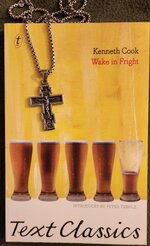
It's based on an excellent book and the film adaptation is one of the best you'll find. Here's my copy.

Wake in Fright.jpeg
 
Living where I do, where the water goes down the drain clockwise, most of what I know about 'Straya comes through the telly, so here's one of the best films ever made down under, Wake in Fright (1971), directed by Ted Kotcheff, who also helmed First Blood (1982) starring Sylvester Stallone.

Wake in Fright is about an effete school teacher stuck in the middle of the outback and who's trying to get to Sydney for the Christmas holiday, but who gets himself stranded in a town full of proper Aussies, those who like to wrestle roos and drink Victoria Bitter, then wrestle each other.

The 1970's were all about demoralization cinema, for example, Walkabout, a much better known Australian film from 1971 that normalizes spurious suicide and indicts the entire white race while atavizing the noble savage aboriginal. Wake in Fright makes its main character the vessel for all of its demoralizing but allows the audience to enjoy the mostly wholesome, or at least vivacious characters around him.

Despite being greenlit for having a depressing protagonist, Wake in Fright has a style and a tone that is interesting and suspenseful, while also providing a character study that reveals the bourgeois effete personality to be a hollow man with no awareness of the weakness that his privation from primitiveness has caused him.

Includes the most graphic kangaroo fight scene in history.


Thanks for posting. I had been trying to remember the name of this film which I believe was discussed in the RVF2.0 film thread. It's going on the list, and I may check out the book as well.
 
Back
Top