2026 Bible Study Thread

Acts 7


Here, Stephen preaches a sermon in his defense. He gives a brief overview of the history of the Old Testament leading up to the New Testament. Whenever the New Testament directly commentates on the Old Testament, you are essentially being given an inspired interpretation. There is much insight in Stephen's sermon here about the biblical history.


You see that from the beginning, Moses' prophethood was called into question. He was repeatedly accused throughout his life by the Hebrews of setting himself up to be put into that position. The irony is that Moses at first rejected the prophethood but God gave him no choice. The point that Stephen is building up to is this: the Jews were rejecting Christ and yet He was truly sent by God to be their Savior just as the Hebrews rejected Moses in his day even though God sent him to be their deliverer. It's easy to look back and say, "I wouldn't have been like those people who rebelled against Moses. I wouldn't have been like those people who crucified Jesus. I wouldn't have been like those people who stoned Stephen. I'm the good guy, not the bad guy. I would've done everything right and nothing wrong." This is what the Jews were saying in those days, even now. The hypocrites. When you say or believe those things, you prove that you are exactly the kind of person who killed the prophets. If you think like this then you are a hypocrite too. You still have the sin of self-righteousness and self-justification in you.


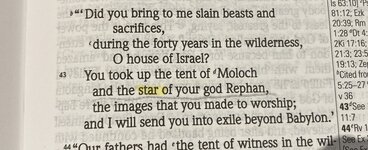
This is why it is a poor argument to appeal to Old Testament shadows to introduce new artistries and idols into the church. God does not accept that which is made by human hands, that is to say He does not accept your works. They may be beautiful to the natural, fallen human eye, but they are repugnant in the eye of God.


There are many parallels between Stephen's martyrdom and Christ's crucifixion. Stephen sees the Son of Man sitting at the right hand of God. At His trial, Jesus said you will see the Son of Man sitting at the right hand of Power. They chased Stephen "out of the city" just as Christ was taken "out of the city." His last words also echo some of Christ's final words "Father, into your hands I commend My spirit." and "Father, forgive them for they know not what they do." Just after He finished preaching a sermon about how the Hebrews hated their own prophets, Stephen was killed for prophesying God's truth to them.
Acts 7:

Just curious could this part be treated as a mantra to seek out expatriation from a fallen immoral West:

'‘Leave your country and your people,’ God said, ‘and go to the land I will show you.’

It's hard to imagine the level of faith needed to have sympathy for those stoning you to death as seen here:

"59;While they were stoning him, Stephen prayed, “Lord Jesus, receive my spirit.” 60&;Then he fell on his knees and cried out, “Lord, do not hold this sin against them.” When he had said this, he fell asleep.
 
Acts 8


Once the Jews saw that they could kill Stephen and get away with it, they began to persecute the Christians. They chased many of the Christians out of the city. But see how God's providence works. When Saul chased the Christians out, he supposed that he had accomplished something for his cause, but God had meant it for good and used it to spread the Gospel abroad.


There is much debate over how regeneration and baptism relate. The truth is that Acts doesn't line up very squarely with most of the popular frameworks. This text right here is unfriendly to Baptismal Regeneration. Baptismal Regeneration is a mechanistic view wherein you receive the Holy Spirit upon being baptized in water, as if the Spirit is forced to oblige the ritual. But this text demonstrates people who had indeed received water baptism, had not yet the Spirit until the Apostles laid hands on them. The Holy Spirit is a not simply a force, energy, or effect that is produced by a ritual. He is a Person and has a will, the will of God. The point of magic is to try to control God, but God will not be controlled.


Speaking of magic, Simon the magician wanted to purchase Apostolic authority. Notice Peter's response. God's gift (literally, His Grace) cannot be bought. It must be given by God and God gives it freely to whom He will. No amount of money, no works, can purchase the grace of God, it is a free gift and a free gift only. It is the same theology as Paul when he says that the wages for sin is death but the free gift of God is eternal life through Jesus Christ our Lord. When the Apostles use the word "bitter", they had a broader meaning than the way we use it today. What they meant was spiritual deadness, like a shrub with no leaves. We tend to mean someone harboring a grudge. Now these can mean the same thing, but they aren't always identical. There are many ways to be spiritually dead, such as pursuing a course of works-based salvation as Simon Magus did.


Some people attempt to use this passage to attack the Bible's clarity in order to assert their own authority. It's as bad as it sounds. They fail to recognize many, many things. First, that they are assuming the clarity of the Bible by appealing to this passage in the first place, so their anti-Scriptural argument becomes self-defeating. But also that Philip proclaimed the Gospel of Christ beginning "from this Scripture." After Philip baptizes the Ethiopian eunuch, he is whisked away by the Spirit to another place.
Acts 8

Philip In Samaria:

'4;Those who had been scattered preached the word wherever they went. 5 Philip went down to a city in Samaria and proclaimed the Messiah there. 6;When the crowds heard Philip and saw the signs he performed, they all paid close attention to what he said. 7;For with shrieks, impure spirits came out of many, and many who were paralyzed or lame were healed. 8;So there was great joy in that city.'

Just curious is it possible to have impure spirits removed with shrieks like this today or nah?

Weird how Simon became such a popular name considering he's a bit of a devious figure in the Bible.

'30;Then Philip ran up to the chariot and heard the man reading Isaiah the prophet. “Do you understand what you are reading?” Philip asked.

31;“How can I,” he said, “unless someone explains it to me?” So he invited Philip to come up and sit with him.'

This is a curious passage which seems to suggest we do need others to interpret the Bible for us. But who deserves such a role and how do they acquire such a title without direct annointment from Jesus or God?

Does it seem a little on the nose that they have an apostle literally interpreting Isaiah to a confused person in the New Testament?

At least it's self-aware but it does feel a bit signposty of 'see- this really is about Jesus!'

The ending paragraph is interesting. Is this suggesting teleportation was a thing among the apostles?
 
This is a curious passage which seems to suggest we do need others to interpret the Bible for us.
If you're a eunuch, maybe. But considering that Paul commends Timothy for knowing the Scriptures from his infancy, that reading just doesn't really hold water. A person who is well versed in the Scriptures can be helpful, but is by no means necessary.

Just curious is it possible to have impure spirits removed with shrieks like this today or nah?
dem success GIF


The ending paragraph is interesting. Is this suggesting teleportation was a thing among the apostles?
At least in this instance. There's actually a few "teleportation" scenes in the Bible. Even a boat seems to teleport in one of them.
 
If you're a eunuch, maybe. But considering that Paul commends Timothy for knowing the Scriptures from his infancy, that reading just doesn't really hold water. A person who is well versed in the Scriptures can be helpful, but is by no means necessary.


dem success GIF


At least in this instance. There's actually a few "teleportation" scenes in the Bible. Even a boat seems to teleport in one of them.
What does being a eunuch have to do with it?

Clearly he's confused by Isaiah and needs someone to help him figure it out.
 
What does being a eunuch have to do with it?

Clearly he's confused by Isaiah and needs someone to help him figure it out.
I was being tongue in cheek. But the fact that you can “clearly” see the narrative says to me that the Scriptures aren’t so unclear after all.
 
Back
Top