I have been studying Japanese and it let me to learn something interesting about the etymology of the days of the week. Apparently the ancient Babylonians developed a system of naming the days of the week after the planets/gods, which spread both westward to Greece/Rome (later Germanic lands) and eastward to China and later Japan. However the matching of the planets/gods and the days actually stayed completely consistent across cultures after all these years, only diff being that Japanese/Chinese system viewed the planets as kind of elemental deities rather than anthropomorphized ones apparently. Somewhat ironically China has now switched to a numerical days of the week system whereas Japanese preserves the ancient one.
| English (Germanic) | Roman | Japanese |
| Sunday | dies Solis | 日曜日 (Sun Day) |
| Monday (Moon Day) | dies Lunae | 月曜日 (Moon Day) |
| Tuesday (Tyr's Day) | dies Martis (Mars = Tyr) | 火曜日 (Fire Star Day = Mars) |
| Wednesday (Woden's Day) | dies Mercurii (Mercury = Odin/Woden) | 水曜日 (Water Star Day = Mercury) |
| Thursday (Thor's Day) | dies Jovis (Jupiter = Thor) | 木曜日 (Wood Star Day = Jupiter) |
| Friday (Frigga's Day) | dies Veneris (Venus = Frigga) | 金曜日 (Gold Star Day = Venus) |
| Saturday (Saturn's Day) | dies Saturni | 土曜日 (Earth Star Day = Saturn) |
Not sure if we got any other etymology nerds on here, I think it's a very underrated element of study that unlocks a lot when you look at the origins of language. I wonder if there were ever any autistic Christian sects who tried to redo the names of the week because of their pagan roots.
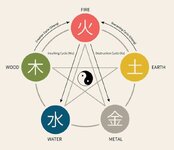
Although they have adopted a modern and simplistic convention for naming the days with numbers, Chinese cosmology of the five elements 五行
wu xing, shown in the chart above (Japan uses the same ideograms), is very interesting.
The Five Elements is one of three prevalent philosophies that is applied to various parts of Chinese culture, including medicine, and categorizes all things into the domain of one of those symbols based on its observed interactions with the other four elements.
The so-called Yin-Yang symbol in the center of the Five Elements flowchart below is the
Tai Ji Tu 太極圖, which is another philosophical system of understanding the interaction of forces.
Such philosophies of non-material forces and their understanding is almost extinct in the post-Enlightenment, materialist West, but even Mao could not wipe it out in China, not that he specifically tried, but so much else was lost.
The chart below shows the observed patterns of different elements creating, destroying or attenuating other elements. Some of the jargon is symbolic and flowery.
In Chinese medicine, wu xing provides a conceptual model that allows for diagnosis and treatment that a few Chinese medicine docs I know have told me is about 80% or more reliable for treatment and predicting how things will go.