Economic consequences of the Iran war

Cooper

Heritage
Catholic
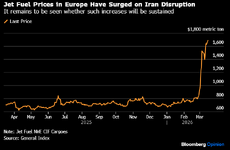
We are heading to a global oil shock that is going to be at least as damaging as the last one from covid if this war drags on. Some countries like those in ASEAN that depend almost exclusively on Gulf oil are going to have to ration their gas, as could EU countries down the road. But even in the US, the price of oil, refined products and other GCC exports is going to surge and potentially push the economy into deep stagflation.


Last edited:
How does Iran deal with reduced sales to its normal customers?

What's their sustainability to continue the war if they have reduced income?

Will Iran continue to sell to China and other non-aligned countries?

For how long can Trump continue the war if oil costs rise?

Will Japan or South Korea defy sanctions and buy from Russia?
 
How does Iran deal with reduced sales to its normal customers?
So far Iranian oil flows without any interruption. Their oil terminals haven't been bombed and their tankers move freely.


What's their sustainability to continue the war if they have reduced income?
They can continue until they empty their stockpiles. But their ability to rebuild their arsenals have been diminished - not because of the economic impact, but because of the strikes on their military-industrial base.


Will Iran continue to sell to China and other non-aligned countries?
As long as we allow them.

For how long can Trump continue the war if oil costs rise?
I don't think oil prices will determine the conclusion of this conflict.

Will Japan or South Korea defy sanctions and buy from Russia?
Japan was already exempt from some of the sanctions against Russia, and Trump recently suspended some of the other sanctions.
 
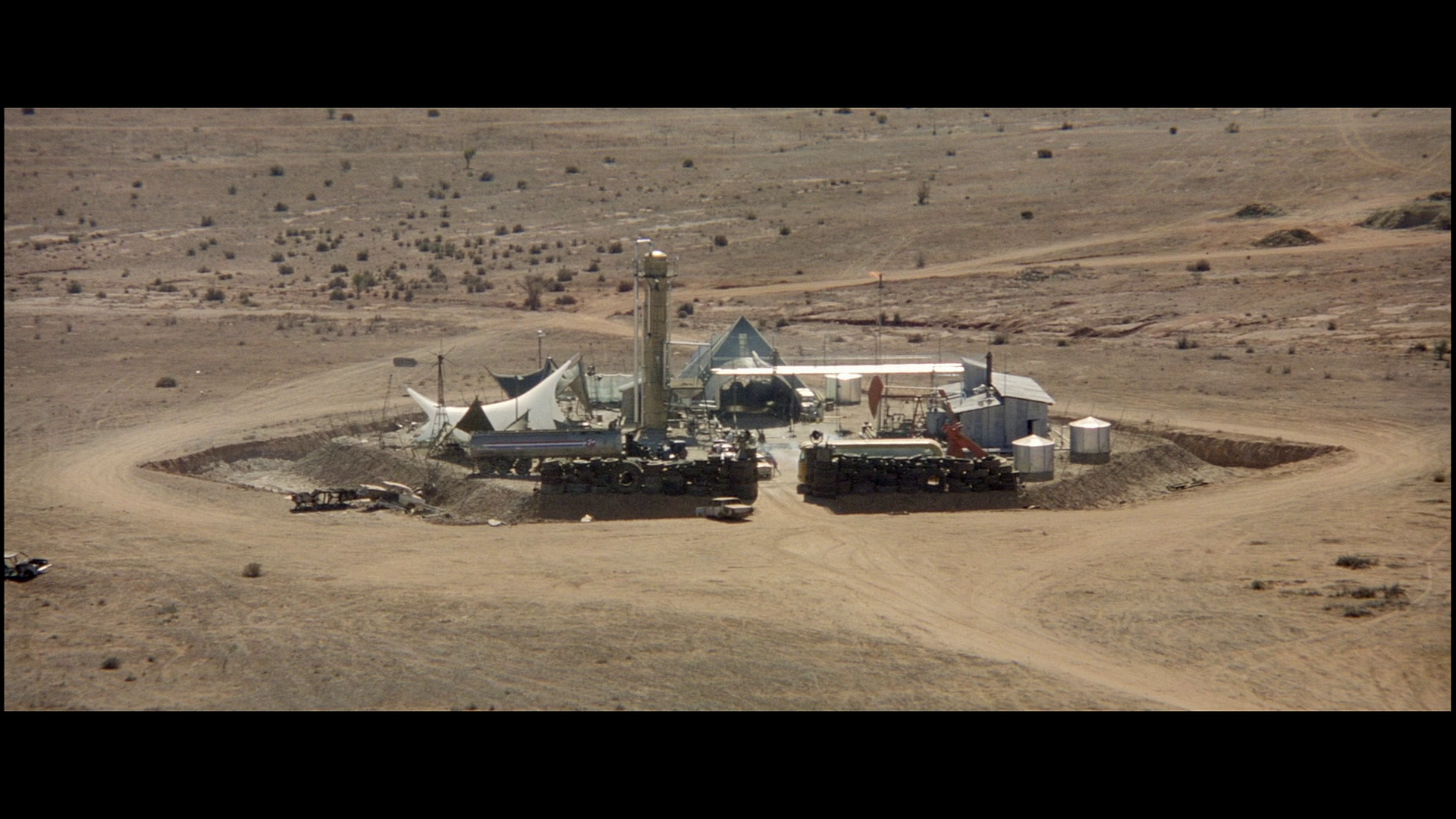
It forces (well if they have any IQ left) Australia to refurbish their refineries and get them back to business asap. Everything runs on diesel here, only lawyers and other rich pricks own EVs in the cities. No joke you have city slickers who will tell you "just get Tesla trucks and electric trains", yes madam but your smashed avocado won't be delivered to you by EVs.

IQ has left though so who knows what kind of winter we're heading in to.
 
It forces (well if they have any IQ left) Australia to refurbish their refineries and get them back to business asap. Everything runs on diesel here, only lawyers and other rich pricks own EVs in the cities. No joke you have city slickers who will tell you "just get Tesla trucks and electric trains", yes madam but your smashed avocado won't be delivered to you by EVs.

IQ has left though so who knows what kind of winter we're heading in to.

mad_max_2_08.png


3867.jpeg
 
Iran cant hold out forever their economy is down too, although they trying to hurt Israel and USA the rest of the world is hurting more right now than USA
 
Some people have been saying South African borders might change because ships will be passing through the cape of good hope once again as it did in the old days, USA has some beef with South Africa at the moment so western and eastern sides of South Africa "might" get some western military support for succession where the major ports are situated. IMG_20260318_102237_909.jpg
 
We are heading to a global oil shock that is going to be at least as damaging as the last one from covid if this war drags on. Some countries like those in ASEAN that depend almost exclusively on Gulf oil are going to have to ration their gas, as could EU countries down the road. But even in the US, the price of oil, refined products and other GCC exports is going to surge and potentially push the economy into deep stagflation.
The solution is very simple: change suppliers.

All countries around the world have been scrambling over the past year to negotiate tariffs with Donald Trump. Now, a perfect opportunity presents itself: just buy oil from the U.S. They get the oil they need, and at the same time they get on Trump’s good side. He may even be generous enough to lower their tariffs.

Beyond that, this is a lesson not to put all your eggs in one basket, and why every country should try to produce its own oil.​
 
Trump temporarily suspends the Merchant Marine Act of 1920 aka the Jones Act, allowing foreign vessels to move cargo between American ports.
The exemption is granted only to ships carrying commodities affected by the war with Iran: oil, gas, fertilizer, etc. Other cargo isn't exempt.
 
Inflation and interest rates going up are more and less a given. Central banks are saying the damage can outlast Trump presidency.

 
Last edited:
The solution is very simple: change suppliers.

All countries around the world have been scrambling over the past year to negotiate tariffs with Donald Trump. Now, a perfect opportunity presents itself: just buy oil from the U.S. They get the oil they need, and at the same time they get on Trump’s good side. He may even be generous enough to lower their tariffs.

Beyond that, this is a lesson not to put all your eggs in one basket, and why every country should try to produce its own oil.​

Not so fast.
First of all, US West Coast doesn't have the infrastructure to support large volume oil exports, so any meaningful transports will have to leave from the Gulf Coast. And this complicates things. You see, supertankers, very large and ultra large crude carriers (VLCC and ULCC) commonly used to deliver oil from the Middle East to Asia are too large to fit through the Panama Canal. Leaving three choices:
- sail east, across the Atlantic, around Africa (supertankers won't fit through the Suez Canal either), across the Indian Ocean, through the Malacca Strait, South China Sea all the way to the Pacific
- sail to Panama and use the Trans-Panama pipeline to send oil to another tanker on the Pacific coast
- charter smaller, Panamax tankers in large numbers to compensate for their smaller size
Either way, there's a problem. Where do You get those tankers from? Even before the Hormuz crisis, tanker fleets had almost no spare capacity. And now it's even worse, with hundreds of tankers trapped inside the Persian Gulf, or idling in the Gulf of Oman. Leaving the very few available tankers in high demand and priced accordingly.

 
Not so fast.
First of all, US West Coast doesn't have the infrastructure to support large volume oil exports, so any meaningful transports will have to leave from the Gulf Coast. And this complicates things. You see, supertankers, very large and ultra large crude carriers (VLCC and ULCC) commonly used to deliver oil from the Middle East to Asia are too large to fit through the Panama Canal. Leaving three choices:
- sail east, across the Atlantic, around Africa (supertankers won't fit through the Suez Canal either), across the Indian Ocean, through the Malacca Strait, South China Sea all the way to the Pacific
- sail to Panama and use the Trans-Panama pipeline to send oil to another tanker on the Pacific coast
- charter smaller, Panamax tankers in large numbers to compensate for their smaller size
Either way, there's a problem. Where do You get those tankers from? Even before the Hormuz crisis, tanker fleets had almost no spare capacity. And now it's even worse, with hundreds of tankers trapped inside the Persian Gulf, or idling in the Gulf of Oman. Leaving the very few available tankers in high demand and priced accordingly.
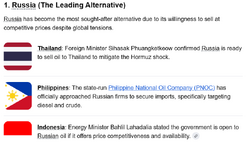
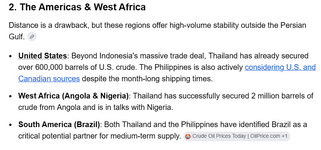
It looks like there are several available options outside of the Gulf countries. Here is the result of a quick Google search:

Screenshot 2026-03-19 084918.pngScreenshot 2026-03-19 084931.png
From this, we can see that Russia and the US are considered serious alternative sources of oil.
 
It looks like there are several available options outside of the Gulf countries. Here is the result of a quick Google search:

View attachment 28116View attachment 28117
From this, we can see that Russia and the US are considered serious alternative sources of oil.

Sourcing oil itself is the easy part, securing the shipping is the problem - You need to find available tankers first, and account for higher shipping rates and extended delivery time.
Even if You cold take one of those empty tankers idling in the gulf of Oman and reroute her to the Gulf of America, it would still take at least 3 months for the first shipment to get to East Asia.
 
Last edited:
Back
Top